


Sizing and Compliance – TUFF SHEATH vs NYY-J
Table of contents
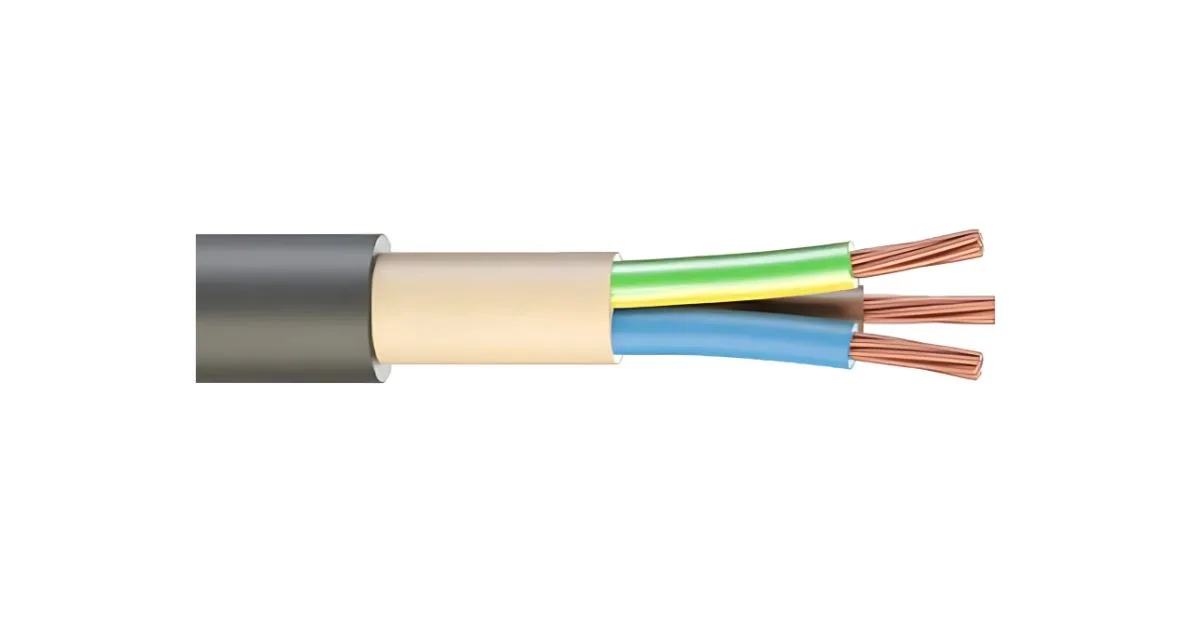
Guide to Hi-Tuff Cable installation: Electricians often ask how to size, route, and protect Hi-Tuff compared to NYY-J and SWA. This guide breaks down the correct approach to cable selection under BS 7671, with special focus on the difference between stranded Hi-Tuff conductors and the often solid NYY-J variants. [1]
Picking the Right Family First
Before installation or sizing, you must identify the cable family:
- Hi-Tuff (TUFF SHEATH):
- Always stranded Class 2 conductors, flexible and easier to handle.
- XLPE insulation rated at 90 °C.
- Current-carrying capacities align with BS 7671 Table 4E4A for thermosetting multicore cables. [1][5]
- NYY-J:
- Typically solid Class 1 conductors (RE) in smaller sizes, with stranded Class 2 (RM) available in larger cross-sections.
- PVC insulation, 70 °C maximum conductor temperature.
- Current ratings follow PVC cable tables in BS 7671. [2][3][4]
Rule of thumb: Hi-Tuff = stranded XLPE, NYY-J = solid PVC (in small sizes).
Installation Method & Environment – Hi-Tuff Cable installation
Hi-Tuff is designed for flexibility:
- ✅ Clipped direct – ideal for industrial distribution.
- ✅ On tray or ladder – common in commercial sites.
- ✅ Embedded in concrete – suitable with correct design.
- ❌ Direct burial without protection – not allowed, as it is non-armoured. Must be in duct or conduit. [1]
By contrast, NYY-J is frequently specified for underground and direct burial, but still requires BS 7671 compliance.
For conditions with high risk of impact or damage, always select SWA Steel Wire Armoured Cables.

Bending Radius, Temperatures, and Mechanical Facts | Hi Tuff Cable
- Hi-Tuff (TUFF SHEATH):
- Min bend radius: 8× cable diameter.
- Temperature: –15 °C → +90 °C.
- Better suited for bends in containment due to stranded cores. [1]
- NYY-J:
- Min bend radius: typically 12× diameter.
- Temperature: –15 °C → +70 °C.
- Solid conductors make it less flexible, particularly at terminations. [2][3][4
- Shop NYY-J Cable
Standards & Compliance Context
Hi-Tuff’s stranded XLPE construction links to BS 7671 Table 4E4A (thermosetting, multicore) rather than PVC tables. [5]
While its construction is tough, it is non-armoured — BS 7671 requires additional mechanical protection for buried runs. In those cases, the correct alternative is SWA cable.
Common Pitfalls to Avoid
- ❌ Using Hi-Tuff for direct burial without ducting.
- ❌ Applying PVC (70 °C) current tables to Hi-Tuff (90 °C XLPE).
- ❌ Forgetting minimum bend radius at terminations.
- ❌ Treating Hi-Tuff as an alternative to SWA — it is not.
FAQs – Guide to Hi-Tuff Cable installation
Q1. Can Hi-Tuff be installed underground?
Yes, but only in ducts or with mechanical protection. For direct burial without protection, use SWA cables. [1][5]
Q2. Why is Hi-Tuff easier to handle than NYY-J?
Because Hi-Tuff is stranded, while NYY-J is often solid-core in smaller sizes. [2][3][4]
Q3. Which tables in BS 7671 apply to Hi-Tuff?
Table 4E4A for thermosetting 90 °C multicore cables. [5]
Q4. What happens if I bend Hi-Tuff too tightly?
It risks insulation cracking and conductor stress. Always respect the 8× diameter bend radius. [1]
Q5. Where should SWA be used instead of Hi-Tuff?
In outdoor runs with risk of damage, or where BS 7671 mandates armour. [5]
Social Media Section
⚡ Want practical tips on Hi-Tuff installation and cable sizing?
- YouTube: Electrical4Less – watch product demos
- Instagram: electrical_4_less – real installs
- Facebook: Electrical4Less Wholesaler – join the trade community
References
[1] Doncaster Cables TUFF SHEATH Datasheet (PDF)
[2] Eland Cables – NYY-J & NYY-O Overview
[3] LAPP – NYY-J / NYY-O Range
[4] IET Wiring Regulations (BS 7671) Guidance






























Guide to Hi-Tuff Cable Installation