


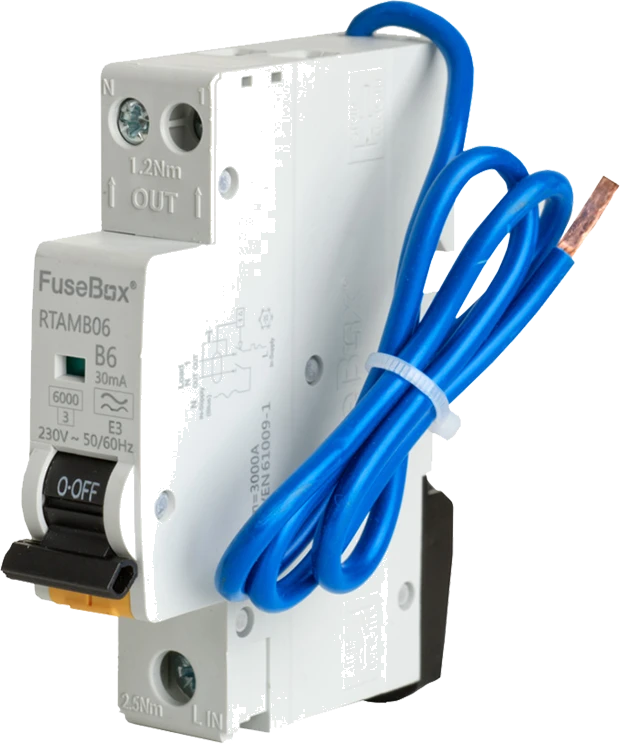
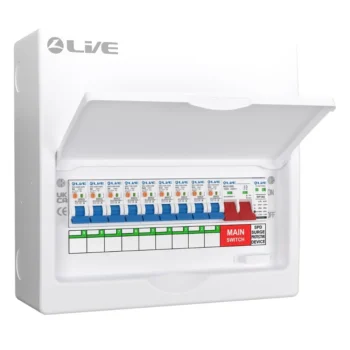
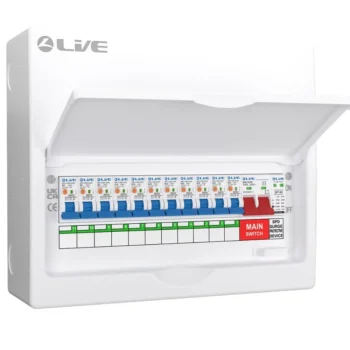
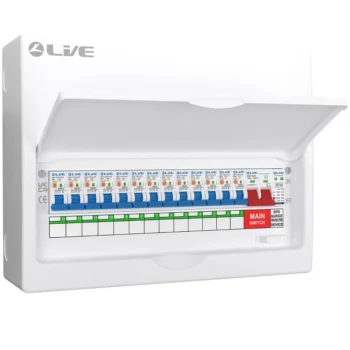
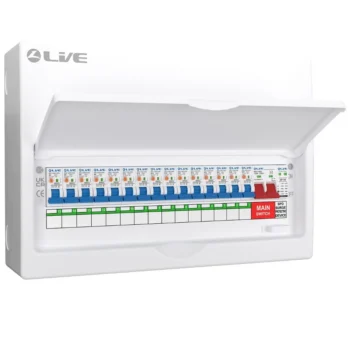
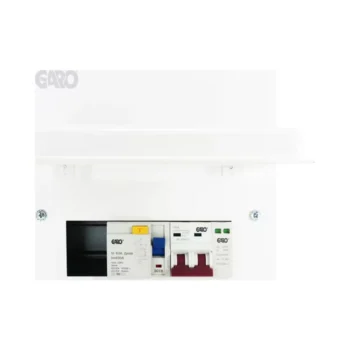
This FuseBox RCBO Installation Guide explains what FuseBox RCBOs are used for, how they work and what to check before selecting a device for a compatible FuseBox consumer unit. It covers Type A protection, bi-directional options, wiring considerations, board compatibility, current ratings, tripping curves and general installation checks for electricians and installers.
Looking for FuseBox RCBO products? Browse our FuseBox RCBO category, or view our main RCBO circuit breakers range for other brands and ratings.
What Is a FuseBox RCBO?
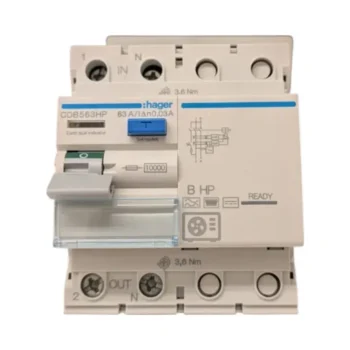
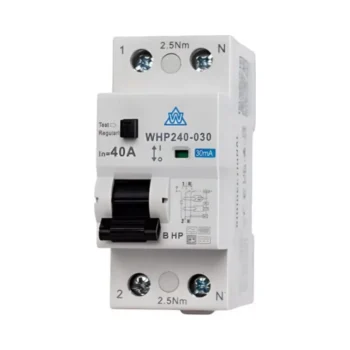
An RCBO is a Residual Current Circuit Breaker with Overcurrent protection.
It combines the functions of:
- An MCB, which protects against overloads and short circuits
- An RCD, which provides residual-current protection
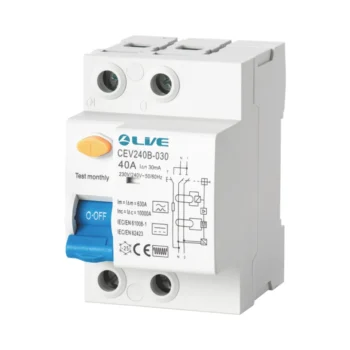
A conventional RCCB or RCD does not normally provide overcurrent protection by itself, whereas an RCBO provides both forms of protection for an individual circuit.
How Does a FuseBox RCBO Work?
A FuseBox RCBO monitors the current flowing through the protected circuit.
During normal operation, the current flowing through the line conductor should return through the neutral conductor. If some current flows through an unintended path, the RCBO detects the imbalance and disconnects the circuit when its operating threshold is reached.
The device also monitors the circuit for excessive current. It will operate when its designed characteristics are exceeded due to an overload or short circuit.
Benefits of Individual RCBO Protection
Using one RCBO for each circuit can provide:
- Individual protection for every circuit
- Improved circuit separation
- Easier fault identification
- Less disruption when a fault occurs
- Residual-current and overcurrent protection in one device
- A compact consumer unit arrangement
If one circuit develops a fault, unrelated lighting, socket or appliance circuits can normally remain operational.
FuseBox RCBOs Compared with MCBs and RCDs
MCB
An MCB protects against overload and short-circuit current. It does not provide residual-current protection by itself.
RCD
An RCD provides residual-current protection but does not normally protect a circuit against overloads or short circuits.
Where several circuits share one RCD, a fault on one circuit may disconnect all the circuits protected by that device.
RCBO
An RCBO combines residual-current, overload and short-circuit protection for an individual circuit.
Type A FuseBox RCBOs
Type A RCBOs detect sinusoidal AC and pulsating DC residual currents. They are commonly used in modern installations containing electronic equipment.
The correct RCD type still depends on the connected equipment and the manufacturer’s instructions. A Type A RCBO should not automatically be treated as suitable for every appliance, EV charger, inverter or specialist circuit.
Bidirectional FuseBox RCBOs
Bidirectional RCBOs are designed for circuits where power may flow through the protective device in either direction.
This can be relevant for:
- Solar PV systems
- Battery storage
- Renewable-energy circuits
- Certain EV charging arrangements
- Other circuits capable of importing and exporting power
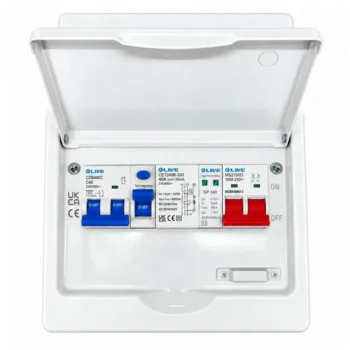
FuseBox offers selected 6kA bidirectional MINI RCBOs with switched line and neutral. The current FuseBox range includes Type A devices designed to provide protection against overloads, short circuits and earth-leakage faults.
Not every RCBO is bidirectional. Directional devices may be marked with line and load, in and out, or arrows showing the intended direction of power flow. The exact device markings and technical information must be checked before installation.
Choosing the Correct FuseBox RCBO
Before selecting a FuseBox RCBO, confirm:
- Current rating
- B or C trip curve
- Breaking capacity
- Residual-current type
- Number of poles
- Whether the neutral is switched
- Bidirectional or unidirectional operation
- Compatibility with the consumer unit
- Requirements of the connected equipment
The protective-device rating must be determined from the circuit design rather than selected only according to the appliance rating.
FuseBox RCBO Current Ratings
FuseBox RCBOs are available in different current ratings for circuits such as lighting, sockets, cooking appliances, heating and specialist equipment.
A higher-rated RCBO does not automatically provide better protection. The device must be coordinated with the cable size, installation method, expected load and required disconnection times.
B Curve and C Curve RCBOs
B curve RCBOs are commonly used for domestic circuits with ordinary starting currents.
C curve RCBOs may be selected for suitable equipment with higher inrush current, but the circuit design and earth-fault loop impedance must support the required operating characteristics.
The electrician should not substitute a C curve device for a B curve RCBO without checking the complete circuit design.
6kA and 10kA FuseBox RCBOs
The breaking capacity indicates the level of prospective fault current the device is designed to interrupt safely.
The required breaking capacity depends on the prospective fault current at the point where the RCBO is installed. This must be confirmed through assessment and testing rather than assumed from the type of property.
How Is a FuseBox RCBO Wired?
The connection arrangement depends on the exact FuseBox RCBO range and consumer unit.
Some RCBOs use a flying neutral lead, while other devices may switch both the line and neutral conductors. Bidirectional models can also have different terminal arrangements from older unidirectional devices.
Before installation, the electrician must check:
- Supply and load terminal markings
- Line and neutral connections
- Busbar compatibility
- Any flying neutral or functional earth lead
- Manufacturer torque settings
- Device orientation
- Whether the RCBO is bidirectional
FuseBox RCBOs must be installed according to the instructions supplied with the exact device. Installation, inspection and testing should be completed by a suitably qualified electrician.
FuseBox Consumer Unit Compatibility
FuseBox RCBOs should only be installed in consumer units or distribution equipment for which compatibility has been confirmed.
Protective devices from different manufacturers should not be mixed on the same busbar simply because they appear to fit. Differences in terminal positions, busbar dimensions and enclosure testing may affect the safety and performance of the completed assembly.
When replacing an existing FuseBox RCBO, check the product range and reference rather than relying only on the current rating.
FuseBox RCBOs for Solar and Battery Storage
Solar PV and battery-storage circuits may allow current to flow in either direction through a protective device.
Where bidirectional operation is required, the selected RCBO must be suitable for reverse power flow. The installer must also check the inverter or battery manufacturer’s requirements, circuit design, isolation and surge protection.
Can FuseBox RCBOs Be Used for EV Chargers?
A FuseBox RCBO may form part of an EV charging installation, but the correct protective arrangement depends on the charger specification.
The installer must consider:
- Required RCD type
- DC residual-current protection
- Disconnection of live conductors
- Open-PEN protection
- Earthing arrangement
- Charger manufacturer’s instructions
Where suitable DC residual-current protection is included in the charging equipment, a Type A or Type F RCD may be used in appropriate designs. Where it is not included, different protection may be required.
Testing a FuseBox RCBO
RCBOs must be tested after installation as part of the inspection and certification process.
The test button should also be operated at the intervals stated on the device or in the manufacturer’s instructions.
An RCBO that trips repeatedly should not simply be reset without investigation. Frequent operation may indicate a fault with the wiring, circuit or connected equipment.
What Causes an RCBO to Trip?
A FuseBox RCBO may operate because of:
- Circuit overload
- Short circuit
- Earth leakage
- Damaged wiring
- Faulty appliances
- Moisture entering electrical equipment
- Combined leakage from several connected devices
The cause should be identified before the circuit is returned to normal service.
Conclusion
FuseBox RCBOs protect individual circuits against residual current, overloads and short circuits. They can improve circuit separation and make electrical faults easier to identify compared with circuits sharing one RCD.
The correct RCBO must be selected according to its current rating, trip curve, breaking capacity, RCD type, direction of operation and compatibility with the consumer unit.
Electrical4Less supplies FuseBox RCBOs at competitive online trade prices, with UK delivery and collection from our Fulham trade counter.







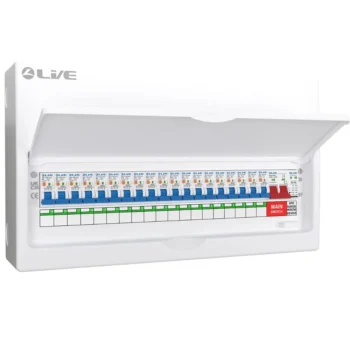
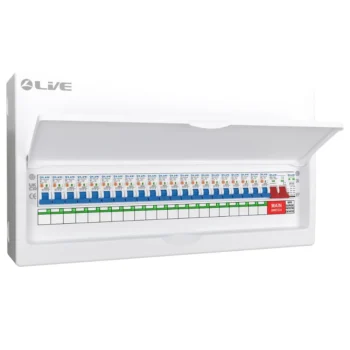

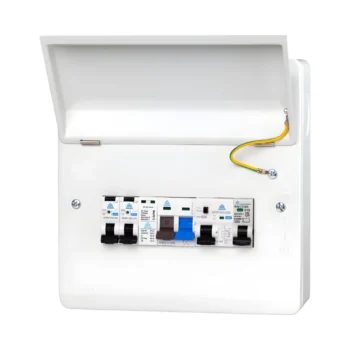
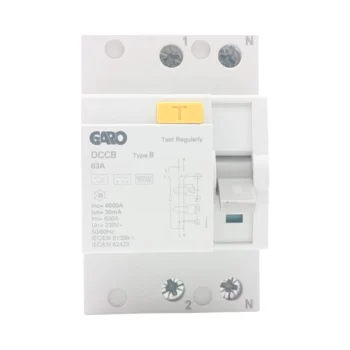




























FuseBox RCBO Guide for UK Installations