


How Wiska COMBI Junction Boxes Protect Connections
Understanding how Wiska COMBI junction boxes protect connections helps electricians select and install electrical enclosures correctly. The Wiska COMBI range uses protective housing materials, cable-entry membranes, sealing arrangements and purpose-designed mounting features to help protect electrical connections against dust and moisture. This guide explains how those features work, the difference between IP66 and IP67 protection, and the installation mistakes that can compromise an enclosure’s performance.

How Wiska COMBI Junction Boxes Protect Connections in Practice
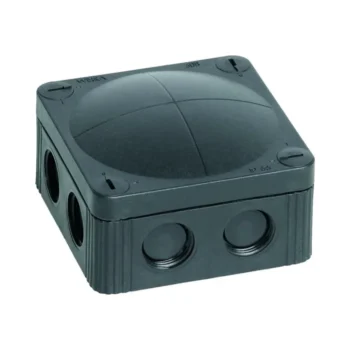
A junction box provides an enclosure for suitable electrical connectors and terminations. Its protective function depends on the enclosure body, cover, cable-entry points and the way those components are assembled.
Wiska COMBI boxes use several features to support the manufacturer’s specified environmental protection:
- Enclosure bodies made from materials selected for the intended application.
- Cover and sealing arrangements designed to limit dust and water ingress.
- Integrated cable-entry membranes on selected models.
- Threaded cable entries that can accept appropriate glands.
- Designated mounting positions intended to preserve the enclosure’s sealing area.
- A range of sizes to accommodate different connection arrangements.
No single feature provides complete protection by itself. The cable entries, lid and mounting method must all be suitable for the finished installation.
Wiska COMBI Materials and Weather Resistance
Wiska describes the COMBI range as using UV- and ozone-resistant materials suitable for specified indoor and outdoor installations.
For example, several COMBI models use polypropylene enclosures with thermoplastic elastomer sealing components. Other larger or specialist versions may use different materials.
Wiska also publishes individual product characteristics such as operating temperature ranges, impact performance and glow-wire test results.
These characteristics should not be assumed to be identical across every COMBI model. Check the technical data sheet for the exact product code before selecting an enclosure for demanding conditions.
The manufacturer provides an overview of the range through its Wiska COMBI Series information.
IP66 vs IP67 – How COMBI Cable Entries Affect Protection
One of the most important aspects of Wiska COMBI installation is the cable-entry arrangement. Wiska explains that suitable models can achieve different ingress protection ratings depending on whether a membrane or an appropriate cable gland is used.
IP66 with Suitable Membrane Entries
IP66 indicates dust-tight protection and resistance to powerful water jets under defined test conditions.
For selected COMBI boxes, Wiska specifies IP66 when the designated cable-entry membranes are used correctly with cables within the permitted dimensions.
The membrane must form an appropriate seal around the cable sheath. Damaged entries or unsuitable cable diameters may compromise that seal.
IP67 with an Appropriate Cable Gland
IP67 indicates dust-tight protection and resistance to temporary immersion under defined test conditions.
For specified COMBI models, Wiska states that IP67 can be achieved using the threaded entry together with a suitable ESKV cable gland.
Not every cable gland is interchangeable. The gland must be appropriate for the enclosure entry, cable diameter and manufacturer’s stated installation method.
IP67 should not be interpreted as unlimited waterproofing or suitability for permanent submersion.
See Wiska’s official explanation of COMBI cable entries for details of the available arrangements.
How Wiska COMBI Cable-Entry Membranes Work
Some COMBI models feature an integrated combination of threaded and membrane cable entries.
This allows the installer to introduce a compatible cable through the designated membrane or use an appropriate gland when the application calls for the alternative entry method.
Wiska also uses threadless membrane entries on certain models, while others have knockout-style entry arrangements. The exact method varies across the product family.
Always identify the entry type before preparing the cable. Do not treat every membrane as a conventional knockout that must be completely removed.
The following checks are important:
- Confirm the manufacturer’s permitted cable diameter range.
- Follow the recommended method for introducing the cable.
- Avoid unnecessary cutting or damage to the membrane.
- Ensure the cable sheath is correctly seated through the entry.
- Check unused entries remain appropriately sealed.
Rear Cable Entries for Wall-Mounted Installations
Wiska specifies rear self-sealing membrane entries on selected COMBI models, including the 108, 206, 407, 607 and 1210.
These can provide a convenient entry arrangement where the cable approaches from behind the enclosure, such as through a wall or other suitable mounting surface.
Using rear entries may produce a neater installation by avoiding unnecessary visible cable runs.
However, the rear entry must be suitable for the cable diameter and installed according to Wiska’s instructions. The mounting surface and cable route should not introduce a path for moisture to collect or enter the enclosure.
Why Wiska COMBI Boxes Have a Bellied Cover
Wiska identifies the bellied cover as a distinctive feature of the COMBI range, providing approximately 10% additional installation space compared with its reference design.
This can help when arranging cables and connectors within a suitable enclosure.
Additional space does not mean unlimited connection capacity. Installers must still consider conductor bending, connector dimensions, cable entry positions and the manufacturer’s product limitations.
The lid must sit correctly against its sealing arrangement. Trapped conductors or an incorrectly positioned cover may compromise both the installation and the intended protection rating.
Quarter-Turn Screws and Access for Maintenance
Wiska specifies captive, rust-resistant, quarter-turn cover screws on selected COMBI models, including the 206, 308, 407, 607, 1010, 1210 and 1610.
These fasteners are designed to make opening and closing the lid more convenient while keeping the screws attached to the cover.
Correctly securing the cover is important for maintaining the intended sealing arrangement. Do not assume that a partly fastened lid offers the same level of protection as a correctly assembled enclosure.
Mounting a Wiska COMBI Box Without Compromising Its Seal
Many COMBI models provide designated fixing positions, mounting clips or internal fixing openings outside the sealing area.
These mounting arrangements are important because drilling arbitrary holes through an enclosure can introduce additional routes for water or dust.
Before mounting the box:
- Identify the manufacturer’s recommended fixing positions.
- Check the mounting surface and the required orientation.
- Use suitable fixings for the surface and enclosure.
- Avoid additional openings that are not permitted by the manufacturer.
- Check that the cover and any sealing components remain undamaged.
The correct mounting method depends on the exact COMBI model. Follow its technical documentation rather than assuming every enclosure has the same fixing arrangement.
Wiska COMBI Models and Different Installation Requirements
The COMBI range includes several enclosure sizes and shapes. These allow electricians to select a model according to the required internal space, entry arrangement and application.
- COMBI 206 – compact rectangular enclosure for suitable smaller connection arrangements.
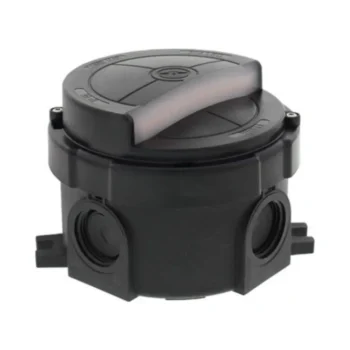
- COMBI 304 – circular enclosure format for appropriate compact applications.
- COMBI 308 – square enclosure offering a different cable-entry layout.
- COMBI 407 and 607 – larger enclosure options with different cable-entry arrangements.
- COMBI 1010 and 1210 – larger versions providing additional space and configurations.
- COMBI 1610 – a larger model intended for installations needing its particular enclosure dimensions and features.
For dimensions and model comparisons, read our separate Wiska COMBI buying guide.
COMBI Boxes with Integrated Terminal Blocks
Some COMBI junction boxes are available with terminals already fitted, while other versions are supplied as empty enclosures.
The Wiska COMBI 1210/5 Black, product code 10101463, is one example of a box supplied with a five-pole terminal arrangement.
The supplied terminals have their own conductor, voltage and current specifications. These must be checked against the requirements of the circuit.
When ordering, check the complete manufacturer code to confirm whether the enclosure includes terminals. A plain COMBI 1210 should not automatically be assumed to have the same equipment as a COMBI 1210/5.

Wiska COMBI Junction Boxes with WAGO 221 Connectors
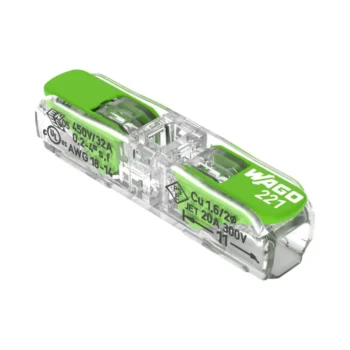
Selected Wiska COMBI variants are supplied with WAGO lever connectors as part of their specified product configuration.
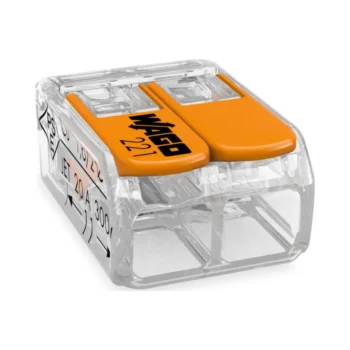
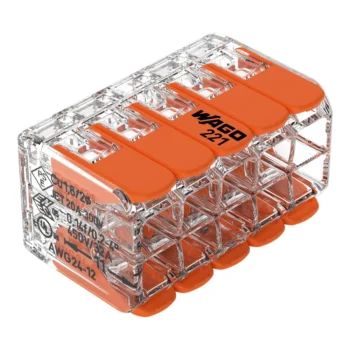
For example, the Wiska COMBI 407/3 BK, manufacturer code 10109673, includes three WAGO 221-413 three-conductor connectors on a carrier fitted to a mounting plate.
These connectors are not supplied with every COMBI enclosure. Other versions may be empty or have a different type of terminal block.
Where connectors are purchased separately, select them according to their conductor compatibility, electrical ratings and the available internal space.
See our WAGO 221 connectors and accessories for additional suitable connector products.

Choosing Cable Glands for Wiska COMBI Enclosures
Where the installation requires a conventional cable gland, the gland must be suitable for the cable and the designated enclosure entry.
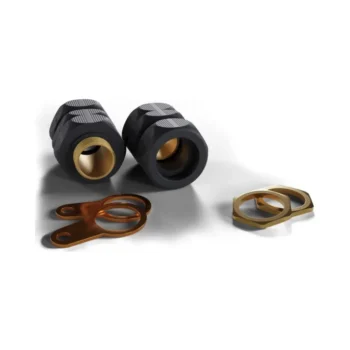
Wiska offers polyamide cable glands for compatible non-armoured cable applications.
For SWA installations, select a suitable brass armour termination gland and the appropriate protective earthing arrangement.
Do not assume that every COMBI enclosure can accommodate every SWA gland size or cable construction. Check entry dimensions, enclosure space and fitting requirements.
Common Installation Mistakes That Reduce Enclosure Protection
Even a correctly selected junction box can fail to provide its intended environmental protection if it is installed incorrectly.
- Using cables outside the permitted membrane or gland diameter range.
- Cutting away too much of a cable-entry membrane.
- Leaving an unused entry without its required seal.
- Drilling unnecessary fixing holes into the enclosure.
- Failing to seat the lid correctly against its sealing arrangement.
- Trapping conductors or other components between the lid and box.
- Overcrowding the internal space with unsuitable terminals or connectors.
- Assuming an IP66 membrane arrangement provides IP67 protection without the specified gland configuration.
A final inspection should consider the enclosure body, cable entries, glands, lid and mounting arrangement together.
Do Wiska COMBI Boxes Guarantee BS 7671 Compliance?
No. A Wiska COMBI junction box provides specified product characteristics, but it does not guarantee compliance for an entire electrical installation.
The electrician must select suitable equipment and ensure that connections are correctly made, protected and inspected according to the applicable installation requirements.
Manufacturer data sheets help establish product suitability. The completed installation must still be assessed against BS 7671 and any other relevant requirements.
Official Wiska COMBI Technical References
For the manufacturer’s current installation details, consult these resources:
- Wiska COMBI Series – Product Features
- Wiska COMBI Cable-Entry Arrangements
- COMBI 407/3 BK with WAGO Connectors – Data Sheet
- COMBI 407/5 WH – Technical Data Sheet
Electrical4Less – Wiska COMBI Supplies for UK Electricians
Electrical4Less supplies Wiska COMBI junction boxes and compatible installation accessories through our independent electrical wholesale business in Fulham, London.
Our trade counter is located at 9 Seagrave Road, Fulham, London SW6 1RP. Customers can collect eligible orders locally or order online for UK delivery, subject to product availability and our delivery terms.
Electrical4Less is a member of the Independent Buying Association (IBA) and the Electrical Distributors’ Association (EDA). Wiska UK is an established IBA supplier partner, connecting the manufacturer with independent electrical wholesalers.
In 2026, Electrical4Less was a Website of the Year finalist at the London Chamber of Commerce SME London Business Awards and shortlisted for Best Wholesaler (1–5 Branches) at the Electrical Wholesaler Awards.
Our dedicated Wiska COMBI product category helps electricians compare enclosure sizes, terminal configurations and current availability.
Frequently Asked Questions About Wiska COMBI Protection
For further information, explore our Wiska COMBI outdoor installation guide or browse the Wiska COMBI range at Electrical4Less.


























Leave a Reply