


Table of Contents
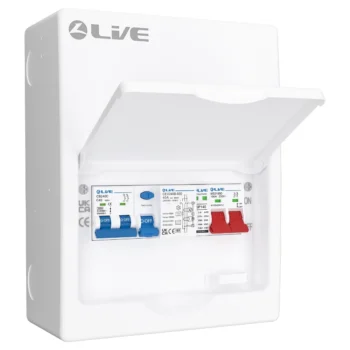
Are Live Electrical consumer units any good? For electricians comparing consumer unit manufacturers, the answer depends on the type of installation, the protective devices required and the available space. Live Electrical offers a varied selection of metal consumer units, including conventional main-switch boards, surge-protected enclosures, populated RCBO kits, flush-mounted designs and its newer SRN double-pole busbar system.
At Electrical4Less, we supply Live Electrical products to electricians and contractors across the UK. In this guide, we examine what the manufacturer offers, the practical advantages of its consumer units, the differences between its ranges and the limitations that installers should understand before selecting a board.

What Makes a Good Consumer Unit?
A consumer unit distributes electrical power to individual circuits and accommodates the protective and switching devices required by the installation. In a modern domestic installation, these may include a main switch, residual-current protection, overcurrent protection and surge protection.
Judging whether a consumer unit is good involves more than examining its price or appearance. Electricians should consider:
- Suitability of the enclosure and assembly for the intended installation.
- Compliance with the applicable product standard, including BS EN IEC 61439-3 where relevant.
- Availability and compatibility of protective devices.
- Space for cables, terminations and future circuits.
- Choice of main switch, RCBO and surge protection arrangements.
- Clear manufacturer documentation and installation instructions.
- Overall cost, including protective devices and accessories.
Live Electrical provides several options addressing these requirements, but their suitability must be assessed for each particular installation.
Are Live Electrical Consumer Units Good Quality?
Live Electrical is an established supplier of consumer units and circuit protection equipment for the UK electrical market. Its range includes metal enclosures in different sizes, with optional or integrated protective-device configurations.
A useful advantage is the breadth of the product range. Rather than offering one standard design, Live Electrical supplies conventional surface-mounted consumer units, populated RCBO kits, SRN double-pole busbar boards and flush-mounted alternatives.
The company’s compact RCBO options and different enclosure configurations may also be attractive where installation space is limited.
However, statements such as “best quality” or “most reliable” would require independent comparative testing. A manufacturer’s declared compliance and product specifications are important, but they do not establish that its consumer units outperform every competitor.
Our assessment is therefore based on practical features, available configurations and the importance of correct device compatibility, rather than unsupported performance rankings.

What Types of Consumer Units Does Live Electrical Make?
One of the most important considerations when choosing Live Electrical is understanding that its different consumer unit systems are not necessarily interchangeable.
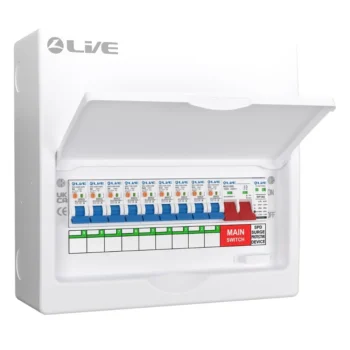
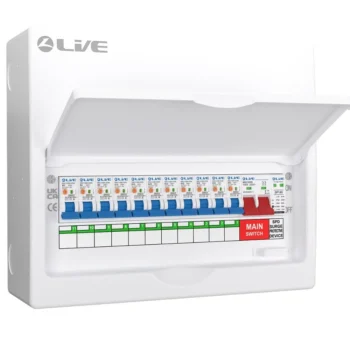
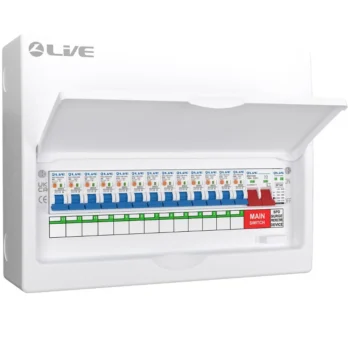
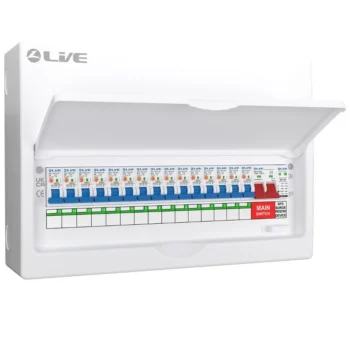
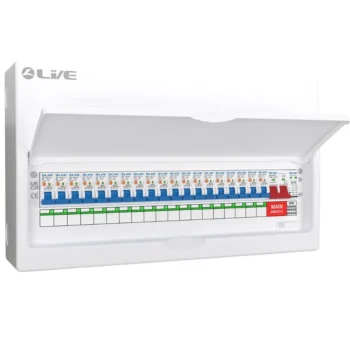
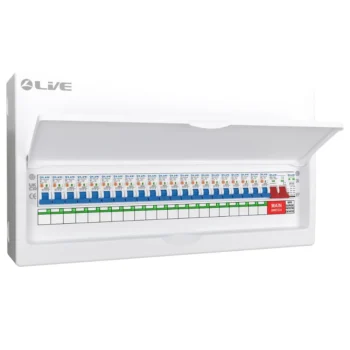
1. LSMC Surface-Mounted Metal Consumer Units
The LSMC range includes conventional surface-mounted metal consumer units with different numbers of usable outgoing circuit ways.
Options include main-switch consumer units and versions equipped with Type 2 surge protection. Different enclosure sizes allow the installer to choose a board suited to the anticipated number of circuits.
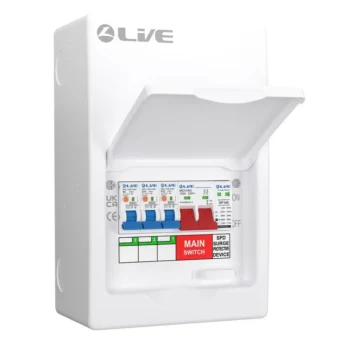
For example, the Live Electrical LSMC8M-SP is a five-way SPD consumer unit with a 100A main switch.
Importantly, the 8M designation does not mean that the board has eight usable outgoing circuit ways. The manufacturer and product listing identify five usable ways for this configuration.
Other LSMC SPD configurations include 7-way, 9-way, 11-way, 13-way, 15-way and 19-way options. The correct number of usable ways should always be taken from the actual product specification.
2. SRN Double-Pole Busbar Consumer Units
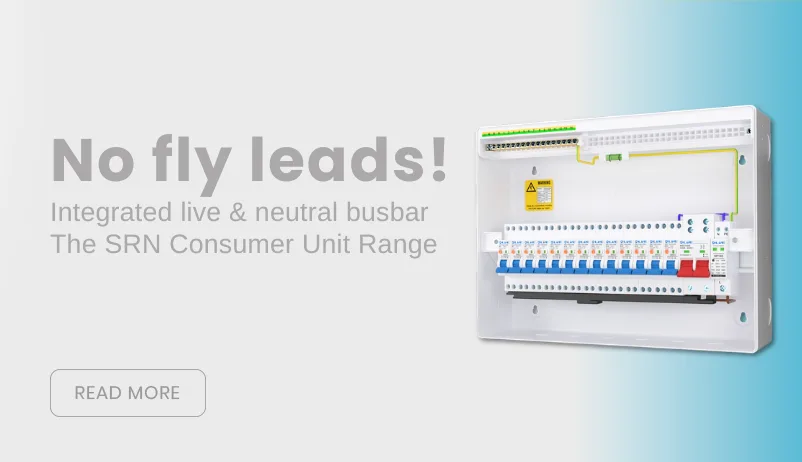
The SRN system is an important addition to the Live Electrical consumer unit range. These boards use a double-pole busbar arrangement and dedicated compatible protective devices.
Available surface-mounted SRN consumer units include selected main-switch and Type 2 SPD configurations. Electrical4Less lists SRN boards under product codes such as LSMC10S-SP, LSMC12S-SP and LSMC14S-SP.
Compatibility warning: SRN consumer units require their specified SRN-compatible devices. Conventional RCBOs must not be fitted simply because their dimensions appear similar.
Live Electrical’s RNC double-pole RCBO family is associated with the SRN system. The manufacturer-approved busbar connection and device arrangement must be followed.
This is one reason installers should not choose protective devices based solely on current rating, tripping curve or physical width.
3. Flush-Mounted Consumer Units
Live Electrical also offers flush-mounted metal consumer units for installations where a recessed finish is preferred.
These can be useful for projects where the visual appearance of the consumer unit matters and sufficient wall depth is available.
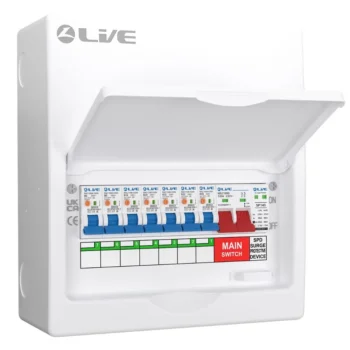
For example, the FMC10M-SP is listed as a seven-way flush-mounted consumer unit with a 100A main switch and SPD.
Before selecting a flush-mounted enclosure, the installer should assess the wall construction, recess dimensions, cable routes, access requirements and manufacturer’s installation instructions.
4. Populated RCBO Consumer Unit Kits
Live Electrical populated consumer unit kits combine a metal enclosure with a specified selection of RCBOs and other accessories.
These kits can simplify purchasing by supplying an identified combination of compatible components rather than requiring every item to be ordered separately.
For example, the Live Electrical 15-way SPD metal consumer unit kit includes 11 RCBOs.
The five-way LSMC8M-SP/4RCBO kit provides five usable outgoing circuit ways, four supplied RCBOs and one remaining way fitted with a blanking plate.
A populated kit should not automatically be described as fully populated. The number of included RCBOs and any spare ways must be checked on the individual product listing.
For a detailed explanation, see our article What Comes in a Live Electrical RCBO Consumer Unit Kit?
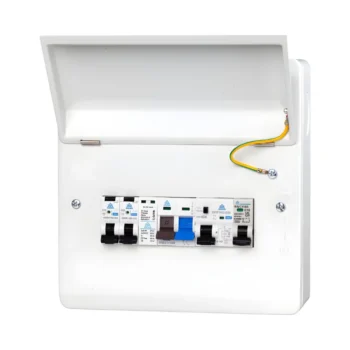
5. Garage and Small Distribution Consumer Units
Live Electrical also supplies compact consumer units for garages, workshops, outbuildings and other smaller distribution requirements.
Some versions incorporate an RCD with MCBs, while others are designed around RCBO protection and may include surge protection.
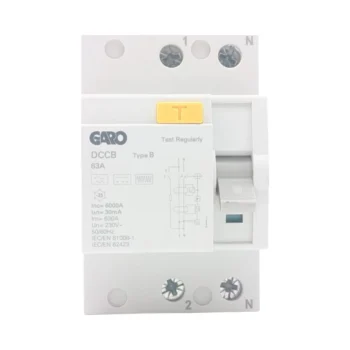
One example is the Live Electrical LSGU63616 garage consumer unit, which is listed with a 63A RCD and 6A and 16A MCBs.
Another current option is the MMGU05-SR garage/EV consumer unit, listed with SPD protection and a 40A RCBO.
These products serve different applications. An EV charging installation, for instance, may require additional protection and equipment-specific measures that cannot be assumed from the enclosure’s name alone.
Live Electrical Consumer Unit Designs Compared
| Range | Main characteristic | Important consideration |
|---|---|---|
| LSMC | Conventional surface-mounted metal boards | Choose correct size and compatible devices |
| SRN | Double-pole busbar system | Dedicated SRN-compatible protective devices |
| FMC | Flush-mounted metal enclosure | Wall construction and recess depth |
| Populated kits | Specified enclosure and RCBO combination | Confirm supplied quantities and ratings |
| Garage/EV units | Compact distribution configurations | Check application-specific protection requirements |
No single range is automatically the best choice for every job. The correct selection depends on the installation, protective-device requirements, physical location and available expansion capacity.

Are Live Electrical RCBOs a Good Choice?
Live Electrical offers several RCBO product families, including compact Type A devices and bidirectional options.
An RCBO combines residual-current protection and overcurrent protection for an individual circuit. In a correctly designed installation, this generally provides better separation of circuit faults than arrangements where several circuits share a single upstream RCD.
However, individual RCBOs cannot guarantee that nuisance tripping will never occur. The connected equipment, circuit condition, leakage currents and protective-device characteristics still matter.
Type A describes the residual-current operating characteristic. B-curve and C-curve describe overcurrent tripping characteristics and should not be confused with Type B residual-current protection.
Bidirectional RCBOs are designed for appropriate operation where electrical power may flow in either direction. This may be relevant to some solar PV and energy-storage arrangements, but it does not mean that every such installation requires the same RCBO.
See the Live Electrical RCBO range for the available device families and specifications.
Is Surge Protection Worth Having?
Many Live Electrical consumer units are available with integrated Type 2 surge protection.
A surge protection device limits certain transient overvoltages that could otherwise damage equipment or contribute to electrical disruption.
Choosing an SPD version can simplify equipment selection where that protection is required. However, the presence of an SPD does not automatically guarantee compliance or protect against every possible overvoltage.
The installer must determine the appropriate SPD arrangement, connections, coordination and installation requirements in accordance with BS 7671 and the manufacturer’s documentation.
Electrical4Less also offers Live Electrical surge protection devices for relevant applications.
Are Live Electrical Consumer Units Easy to Install?
Installation practicality depends on the enclosure design and the space available around the consumer unit.
Live Electrical offers different enclosure sizes, metal constructions and mounting arrangements, giving installers options for conventional surface mounting and recessed installation.
Factors worth checking include cable entry positions, working space, terminal accessibility, enclosure dimensions and the installation of any supplied surge protection equipment.
A compact board may be convenient in a restricted location, but selecting an enclosure with insufficient wiring space or spare ways can make future alterations more difficult.
For this reason, choosing the smallest available enclosure is not always the most practical solution.
Can You Mix Other Brands of RCBOs with Live Electrical Consumer Units?
Protective-device compatibility is one of the most important issues when working with consumer units.
An MCB or RCBO from another brand should not be treated as compatible simply because it fits onto the DIN rail or appears to connect to the busbar.
The consumer unit is an assembly that must be installed and maintained using devices and arrangements approved or properly verified for that assembly.
Different devices can have different busbar connections, terminal positions, contact arrangements and heat dissipation characteristics.
This is especially important with SRN double-pole busbar consumer units, where the manufacturer specifies dedicated compatible devices.
Before replacing or adding any protective device, verify its compatibility with the exact consumer unit model and follow the relevant manufacturer instructions.
Do Live Electrical Consumer Units Comply with the Latest Wiring Regulations?
Live Electrical consumer units are marketed for use in electrical installations subject to the applicable UK product and installation requirements.
For consumer unit assemblies, the relevant product standard includes BS EN IEC 61439-3, while installation requirements are governed by BS 7671.
As of October 2026, BS 7671:2018+A4:2026 is the current edition of the IET Wiring Regulations. Amendment 4 was published on 15 April 2026, and the earlier edition was withdrawn following the transition period ending 15 October 2026.
It is also important to distinguish historical terminology from current requirements. The commonly referenced domestic metal consumer unit enclosure requirement dates from Amendment 3 to the earlier 17th Edition regulations, not Amendment 3:2024 of the 18th Edition.
Compliance cannot be guaranteed merely by purchasing a particular consumer unit. The complete installation must be appropriately designed, installed, inspected, tested and certified.
For the latest regulatory position, consult the IET’s current BS 7671 guidance.
What Are the Limitations of Live Electrical Consumer Units?
A balanced assessment should also consider the potential limitations of the range.
- Device compatibility: Different Live Electrical systems may require different approved RCBO families.
- Kit specifications: Populated kits do not necessarily include an RCBO for every usable way.
- Product selection: Not every consumer unit includes an SPD or the same switching arrangement.
- Specialist loads: Some inverter, EV and other electronic equipment may require particular residual-current protection.
- Installation space: Compact enclosures are not always suitable where substantial cable termination space is needed.
- Future maintenance: Replacement devices must remain available and suitable for the specific assembly.
These are considerations that apply across consumer unit manufacturers, not necessarily faults unique to Live Electrical.
Are Live Electrical Consumer Units Good Value for Money?
Live Electrical’s product range provides buyers with a choice of basic enclosures, SPD configurations and populated RCBO kits at different price points.
To assess value fairly, compare the complete installed equipment requirement rather than the enclosure price alone.
A lower-priced empty enclosure may be less economical once compatible RCBOs, SPD equipment, blanking plates and other accessories are added.
Conversely, a populated kit may include device ratings that are not appropriate for the planned circuits, making a separately configured board a better choice.
Electrical4Less lists both individual consumer units and populated kits, allowing customers to compare the actual supplied configuration before ordering.
Who Should Consider a Live Electrical Consumer Unit?
Live Electrical consumer units are worth considering for electricians who want a choice of metal enclosure sizes, individual RCBO protection, SPD-equipped boards or populated kits.
The SRN system may also appeal to installers specifically looking for its double-pole busbar and compatible device arrangement, while the FMC range offers a flush-mounted alternative for suitable projects.
For garages and smaller distribution installations, the manufacturer’s compact enclosures provide further options.
In every case, device selection and assembly compatibility should be verified against the intended installation rather than choosing a model based on brand or price alone.
Frequently Asked Questions About Live Electrical Consumer Units
Are Live Electrical consumer units any good for domestic installations?
Yes, Live Electrical offers a selection of metal consumer units suitable for consideration in domestic installations. The correct choice depends on circuit requirements, enclosure size, protective-device compatibility and the intended installation.
What is the difference between Live LSMC and SRN consumer units?
Conventional LSMC boards and SRN boards use different protective-device arrangements. SRN features a double-pole busbar system requiring specifically compatible devices. Installers must not assume that RCBOs from the two systems are interchangeable.
Do Live Electrical consumer units include RCBOs?
Some models are sold as populated kits with a stated quantity of RCBOs. Others are supplied as main-switch or SPD-equipped enclosures without the same outgoing devices. Always check the product specification.
Are Live Electrical consumer units available with surge protection?
Yes. Live Electrical offers multiple models with Type 2 surge protection, as well as configurations without the same SPD arrangement. The device and installation must still meet the applicable requirements.
Can I use another manufacturer’s RCBO in a Live consumer unit?
Do not assume compatibility based on the physical fit. The specific consumer unit assembly and approved protective-device arrangement must be checked against manufacturer documentation.
Are Live Electrical consumer units suitable for solar PV?
Some configurations may be suitable as part of a correctly designed installation involving solar PV. However, the inverter manufacturer’s instructions and the required protective-device characteristics must determine the actual equipment selection.
Does a five-way Live consumer unit have five available circuit positions?
The LSMC8M-SP is listed as a five-way SPD consumer unit. Its populated LSMC8M-SP/4RCBO kit contains four supplied RCBOs and one remaining usable way fitted with a blanking plate. The 8M product-code designation should not be interpreted as eight usable outgoing ways.
Are Live Electrical consumer units compliant with BS 7671 Amendment 4?
Individual product suitability and the compliance of the completed installation are separate matters. Electricians must select appropriate equipment and comply with BS 7671:2018+A4:2026, the current edition of the UK Wiring Regulations.
Our Verdict: Are Live Electrical Consumer Units Worth Considering?
Live Electrical consumer units are a credible option for electricians seeking metal enclosures, SPD versions, populated RCBO kits and a choice of surface-mounted or flush-mounted designs.
The range’s main practical advantage is its variety of configurations, allowing the installer to select a suitable system rather than relying on one standard enclosure design.
The key point is compatibility. Conventional LSMC boards and SRN double-pole busbar boards should not be treated as interchangeable, and neither should the associated protective devices.
We would consider Live Electrical alongside other established consumer unit brands, comparing the total configuration, technical suitability, enclosure design and availability of compatible devices before making a final choice.
About Electrical4Less
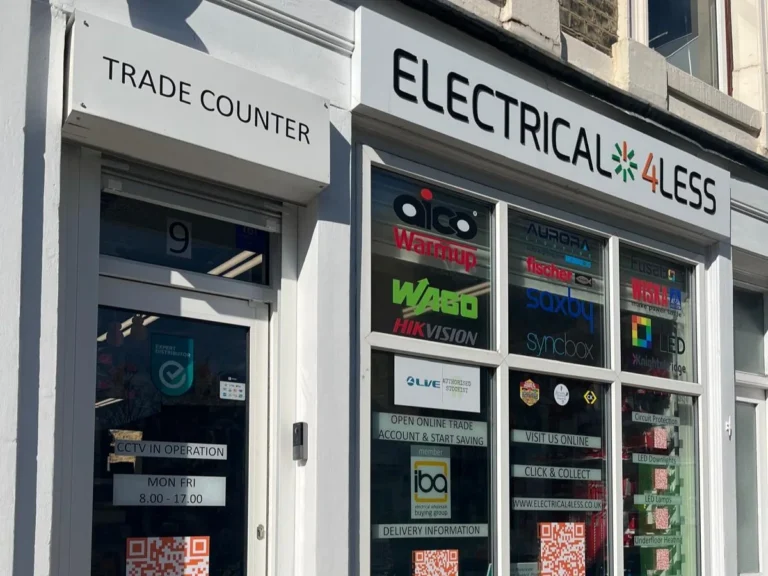
Electrical4Less Ltd is an independent electrical wholesaler based at 9 Seagrave Road, Fulham, London SW6 1RP. We supply professional electricians, contractors and customers throughout the UK with consumer units, circuit protection devices, cables and electrical installation accessories.
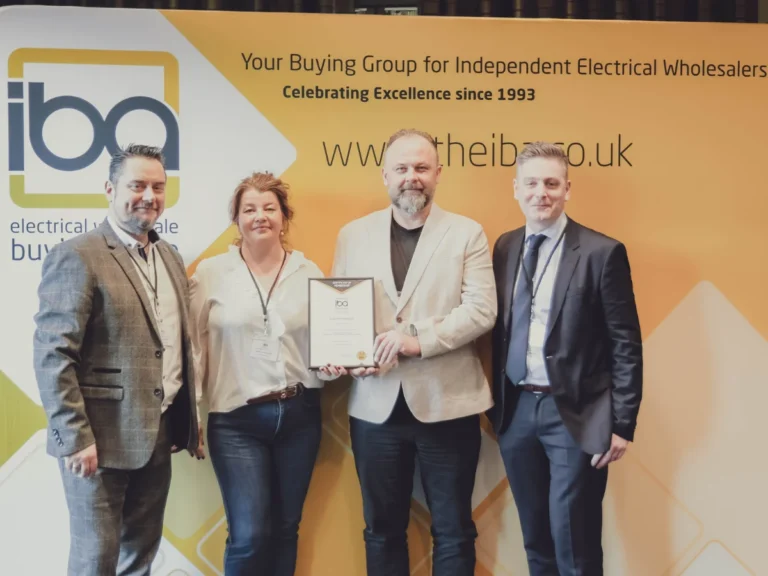
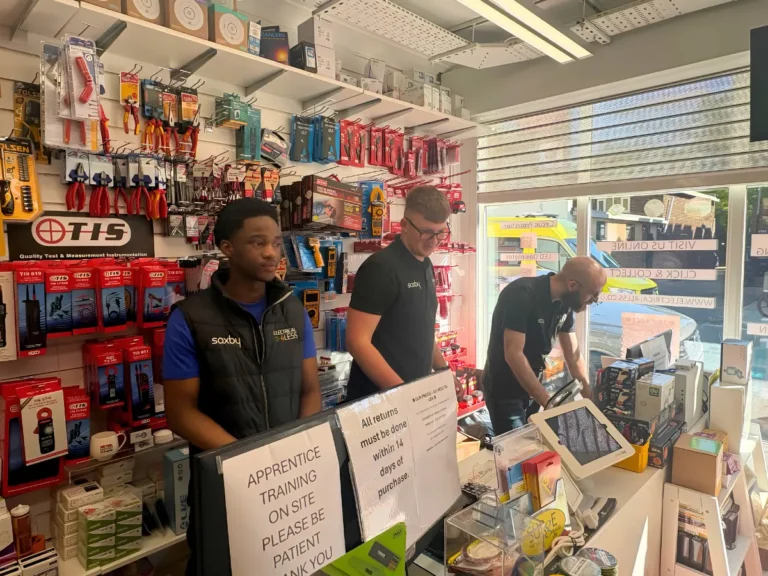
Electrical4Less is a member of the Independent Buying Association (IBA) and the Electrical Distributors’ Association (EDA). We work closely with Live Electrical and offer a selection of its consumer units, RCBOs, SPDs and related products through our online store and Fulham trade counter.
For product specifications and model information, you can also visit the Live Electrical manufacturer website.
Browse our Live Electrical consumer units or explore the Live Electrical RCBO range to check available product options.





















Leave a Reply