


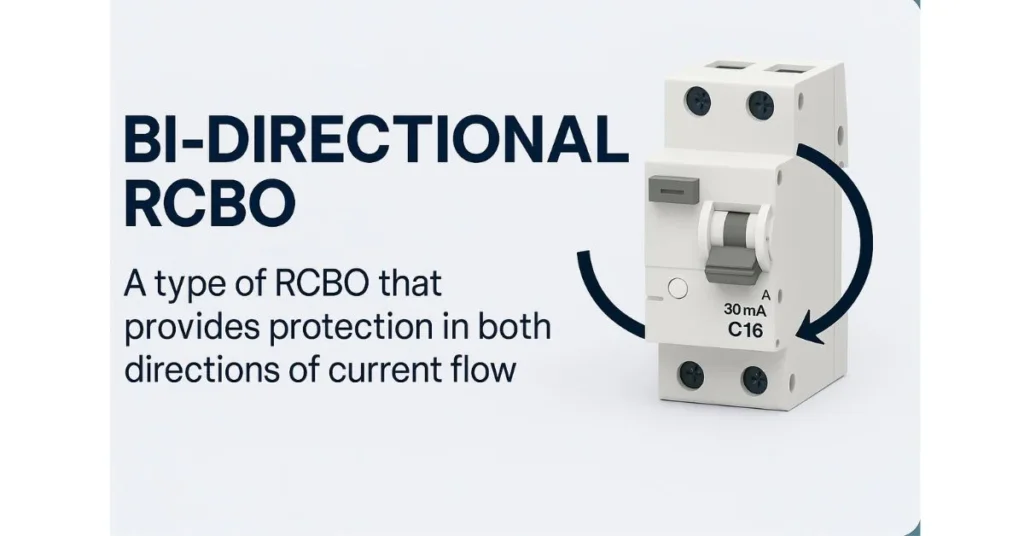
Bidirectional RCBOs (Residual Current Breaker with Overcurrent protection) are advanced electrical devices designed to enhance safety in electrical circuits. These components combine the functionalities of an RCD (Residual Current Device) and an MCB (Miniature Circuit Breaker). This combination allows for the detection of residual currents (earth faults) and provides overcurrent protection. Unlike traditional RCBOs, bidirectional RCBOs can detect current flow in both directions. This bidirectional capability is crucial in modern electrical systems, particularly with the growing use of renewable energy sources and inverter-based installations.
The Need for Bidirectional RCBOs
These RCBOs were developed to address the limitations of unidirectional RCBOs. Traditional RCBOs are designed to detect current flow in a single direction, which suffices for conventional electrical installations. However, with the advent of renewable energy sources, such as solar panels and wind turbines, there is an increasing need for bidirectional current flow. These renewable energy systems often involve the use of inverters, which can change the direction of current flow. Bidirectional RCBOs can detect faults regardless of the current direction, providing enhanced safety for these installations.
Why Bidirectional RCBOs are Gaining Popularity
The popularity of bidirectional RCBOs is on the rise due to several factors. Firstly, the growth of renewable energy installations requires reliable protection for bidirectional current flows. Secondly, the increasing complexity of modern electrical systems necessitates versatile and comprehensive safety solutions. Lastly, regulatory changes and updated safety standards are encouraging the adoption of more advanced protective devices. These factors combine to make these RCBOs an essential component in contemporary electrical installations.
How Bidirectional RCBOs Work
Bidirectional RCBOs function by continuously monitoring the current flow in both directions. When a fault is detected, such as a residual current (earth fault) or an overcurrent (overload or short circuit), the RCBO trips and disconnects the circuit. This tripping mechanism prevents potential hazards, such as electric shocks and fires. The ability to detect faults in both directions ensures that these RCBOs provide comprehensive protection, even in complex electrical systems with bidirectional current flows.
Benefits of Using Bidirectional RCBOs
Bidirectional RCBOs offer several advantages over traditional unidirectional equivalent. Firstly, they provide enhanced safety by detecting faults in both current directions. This feature is crucial for installations involving renewable energy sources and inverters. Secondly, these RCBOs simplify the design and installation of electrical systems, as they eliminate the need for separate protection devices for each current direction. Lastly, these devices comply with the latest safety standards and regulations, ensuring that installations meet current requirements.
Applications of Bidirectional RCBOs
Bidirectional RCBOs are particularly useful in installations with renewable energy sources, such as solar power systems and wind turbines. These systems often involve bidirectional current flows due to the use of inverters. Additionally, these RCBOs are beneficial in complex electrical systems, such as those found in commercial and industrial settings. By providing comprehensive protection, these devices enhance the safety and reliability of a wide range of electrical installations.
Conclusion
In conclusion, these RCBOs represent a significant advancement in electrical protection technology. Their ability to detect faults in both current directions makes them essential for modern electrical systems, particularly those involving renewable energy sources. As the demand for renewable energy and advanced safety solutions continues to grow, the popularity of these RCBOs is expected to increase. These devices not only enhance safety but also simplify the design and installation of electrical systems, making them a valuable addition to contemporary electrical installations.
See our full range of Bidirectional RCBOs here!
FAQ
Our latest posts:
Related Articles
DC-Sensitive Circuit Protection: The Ultimate Safeguard for EV, Solar and Smart Systems
Introduction Electrical installations have changed dramatically in recent years. The simple, predictable loads of the past—heating, lighting, motors—have been replaced by EV…

FuseBox 10kA RCBOs for Three Phase Consumer Units – What You Need to Know
FuseBox 10kA RCBOs for Three Phase Consumer Units – What You Need to Know is critical for electricians working on larger commercial…
FuseBox Compact RCBOs – Space-Saving Options Explained
This FuseBox Compact RCBOs Explained guide covers the compact and mini RCBO options available for compatible FuseBox consumer units. Compact FuseBox RCBOs…





































Bi-Directional RCBOs – Complete Guide