


Consumer Unit Cable Glands Explained
Consumer unit cable glands explained: choosing the correct cable-entry accessories is an important part of a safe and professional fuse board installation. Whether you are routing twin and earth cables, securing meter tails, bringing flexible cables into an enclosure or terminating SWA, each entry needs suitable mechanical protection and, where required, cable retention and sealing. This guide explains the different gland types, rear and surface cable entries, eddy-current considerations and how the latest BS 7671 requirements relate to consumer unit installations.
Consumer Unit Cable Glands Explained – What Are They?
The term consumer unit cable glands describes several types of cable-entry accessories used with electrical distribution boards, often called fuse boards or fuse boxes.
These products help protect cables where they enter an enclosure. Depending on their design, they may also provide cable retention, strain relief or environmental sealing.
Common applications include:
- Flat twin and earth cable entering a domestic consumer unit.
- Meter tails and main earthing conductors entering a distribution enclosure.
- Round flexible cables supplying associated equipment.
- Steel wire armoured cable supplying a submain or outbuilding circuit.
- Multiple supported cables passing through a suitable membrane entry.
The correct product depends on the cable construction, entry location, required mechanical protection, installation environment and enclosure manufacturer’s instructions.
Not every cable requires the same type of gland, and a cable-entry accessory does not automatically establish compliance with BS 7671.
Rear Entry vs Surface Entry in Consumer Units
One of the most important differences is whether cables enter the consumer unit from behind or through an exposed top, side or bottom entry.
Rear Cable Entry
In many domestic installations, a surface-mounted consumer unit receives cables through rear openings from a wall cavity or concealed cable route.
These arrangements are common on brick, block, plasterboard and stud walls.
A compression gland is not necessarily required for every rear-entering flat cable, provided the complete arrangement offers the necessary cable protection, support and retention.
However, where a cable passes through a metal knockout or another potentially damaging edge, suitable protection such as a correctly fitted grommet, bush or other approved entry component is important.
The precise arrangement should follow the consumer unit manufacturer’s instructions and the applicable installation requirements.
Top, Side and Bottom Cable Entries
Where cables enter through the top, side or bottom of a consumer unit, they may be more exposed to movement or mechanical disturbance.
Suitable cable glands, bushes, membrane entries or trunking arrangements may be needed to provide protection and appropriate retention.
The appropriate method depends on cable support, accessibility, enclosure design and the manufacturer’s approved entry arrangements.
Simply fitting a gland does not compensate for inadequately supported cables or a poorly prepared enclosure opening.
1. Membrane Grommets for Consumer Unit Cable Entries
Membrane grommets and membrane cable-entry systems provide flexible entry arrangements for certain cable types.
They may be suitable for flat cables, round cables or multiple conductor entries depending on the exact product.
The membrane forms a barrier around the cable and may offer an IP-rated sealing arrangement when correctly fitted.
However, not all membrane entries provide the same cable-retention performance as a dedicated compression gland.
When selecting a membrane grommet, check:
- The permitted cable dimensions and entry configuration.
- The enclosure hole size or knockout diameter.
- The manufacturer’s specified protection rating.
- Whether cable retention or additional support is required.
- The product’s material and applicable temperature range.
Selected membrane grommets offer IP66 protection, but the rating and temperature performance must be checked for the individual product rather than assumed to apply to every membrane accessory.
See our membrane grommet products for available entry options.
2. Cable Glands for Twin and Earth Cables
Flat twin and earth cable has a different profile from round flexible cable. A gland designed specifically for flat cable can provide a more appropriate gripping and sealing arrangement.
The Twin and Earth Cable Glands category at Electrical4Less includes selected flat-form glands for different cable sizes.
Examples include nylon glands intended for particular flat twin and earth cable configurations.
Suitable glands may provide:
- Protection from the edge of the enclosure entry.
- Retention of the cable sheath.
- Reduced movement at the point of entry.
- A neat and controlled cable route into the consumer unit.
Choose the gland according to the manufacturer’s permitted cable configuration and dimensions. Conductor cross-section alone should not be used to assume compatibility with every flat cable.
A standard round gland should not be used with flat twin and earth cable unless the manufacturer confirms that the particular cable profile is compatible with its sealing and retention arrangement.
3. Meter Tails Glands for Consumer Units
Meter tails glands are designed for particular incoming supply conductor arrangements and can provide a controlled entry through a suitable consumer unit opening.
Many products use a multi-hole insert intended to accommodate specified line, neutral and protective conductor sizes.
The Meter Tails Glands category includes both nylon and metal gland products.
Examples available through Electrical4Less include:
- Wiska TKE/P32 and TKE/P40 meter tails gland kits.
- FuseBox G32T and G50T meter tails glands.
- CTC nylon and brass multi-hole tail gland kits.
- Other compatible M32 and M50 meter tails entry accessories.
These products are available with different cable-hole sizes and entry thread diameters. Check both the gland specification and the actual conductors before ordering.
Why Correct Meter Tails Entry Matters
The meter tails entry should be arranged so the conductors are appropriately protected against mechanical damage and are not subject to unsuitable strain at the main switch terminals.
Where an entry gland provides sealing or cable retention, it must be used according to the manufacturer’s fitting instructions.
Care is also required when routing conductors through a steel enclosure because certain separate-entry arrangements can lead to electromagnetic heating effects.
Meter tails glands can provide a practical method for organising suitable conductors through one opening, but the complete cable route must be assessed.
4. Nylon and Brass Glands – Which Material?
Consumer unit cable-entry products are available in different materials, including polyamide and brass.
Polyamide glands are commonly used where their insulation, mechanical and environmental characteristics suit the application.
Brass glands may be selected for different mechanical requirements or where the particular product provides an appropriate metal entry arrangement.
Neither material automatically guarantees superior protection or compliance. The gland’s construction, permitted cable range, retention characteristics and product specification are more important than material alone.
For example, two meter tails glands may both have M32 threads while using different inserts or accommodating different cable sizes.
Always compare the complete manufacturer’s specifications.
5. Glands for Round Flexible Cables
Round flexible cables may be used with associated electrical equipment where the installation design and equipment requirements permit.
Examples include selected connections to heating equipment, controls or other adjacent equipment.
A suitable nylon compression cable gland may provide a controlled entry and cable-retention arrangement.
Different products offer different sealing ranges and thread sizes, including M20 and M25 options.
Before installation, confirm:
- The cable’s actual outside diameter.
- The gland’s permitted cable sealing range.
- The required mechanical retention.
- The enclosure entry thread or hole size.
- The environmental protection required at the cable entry.
Do not overtighten the gland or compress the cable beyond the manufacturer’s specified installation requirements.
6. SWA Cable Entries into Consumer Units
Steel wire armoured cables may be used for suitable submain circuits or supplies to outbuildings. Where an SWA cable enters a consumer unit or associated enclosure, its termination requires particular attention.
Conventional SWA cable glands and specialist products such as Wiska ShieldGLAND may offer suitable termination options depending on cable construction and installation requirements.
An appropriate SWA termination must provide the required mechanical clamping and suitable electrical continuity arrangements.
Where the armour is used as a protective conductor or requires bonding, its termination must be designed and verified accordingly.
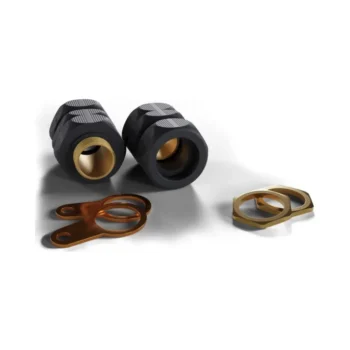
Depending on the gland system and enclosure, suitable accessories may include an earth tag, earthing nut, approved bonding component or manufacturer-specific termination arrangement.
Not every installation requires both an earth tag and an earthing spring. The necessary arrangement depends on the selected gland and the electrical design.
Do not drill unsuitable holes or modify the consumer unit in ways not permitted by the enclosure manufacturer. Where the required SWA gland cannot be accommodated safely, an appropriate external termination enclosure may be considered as part of the installation design.
For more detailed information, see our SWA Cable Glands range and the relevant manufacturer instructions.
7. Eddy Currents in Metal Consumer Units
An important electrical consideration arises when alternating-current conductors pass through separate openings in a ferromagnetic enclosure, such as a steel consumer unit.
Alternating current produces magnetic fields. Under certain conductor arrangements, these fields can induce circulating currents in nearby ferromagnetic metal, potentially causing unwanted heating.
This is particularly relevant to incoming supply conductors and other higher-current circuits.
Why Separate Meter Tails Entries May Be a Problem
Routing individual line and neutral conductors through separate holes in a steel enclosure can create conditions for electromagnetic heating.
The correct arrangement depends on the conductor routing, enclosure construction and applicable electrical installation requirements.
Grouping the associated circuit conductors through a suitable common entry is one established approach, but installers must follow the current BS 7671 requirements and any approved alternative arrangements.
This issue should be considered during installation design, not only when visible heat damage is discovered later.
BS 7671 Amendment 4:2026 – Current Requirements
BS 7671:2018 Amendment 4:2026 was published in April 2026. Following the transition period ending on 15 October 2026, Amendment 4 became the current edition for new electrical installation work.
Regulation 521.5.1 addresses the arrangement of alternating-current conductors in ferromagnetic enclosures and the associated electromagnetic effects.
Installers should consult the current regulation and its associated guidance when considering separate cable entries, conductor grouping and any permitted alternative arrangement.
Do not rely on earlier draft commentary or assume that separate conductor holes are permitted simply because a circuit falls below a particular current threshold. The full requirements of the published standard and relevant equipment documentation must be considered.
The Institution of Engineering and Technology (IET) provides information about the current edition of BS 7671.
8. Cable Entry Protection and EICR Inspections
Cable-entry arrangements are relevant to electrical installation inspection because exposed conductors, damaged insulation, poor cable support or inappropriate gland selection may indicate defects.
However, an Electrical Installation Condition Report (EICR) is not judged on whether all cables have matching glands or whether the consumer unit looks particularly tidy.
Any observation and classification depend on the actual condition, risk, applicable requirements and professional assessment by the inspector.
It would therefore be incorrect to say that a missing gland always results in a C2 observation, or that fitting one guarantees an installation will pass inspection.
Good workmanship involves suitable cable support, correctly selected entry components, appropriate enclosure integrity and properly terminated conductors.
9. Selecting the Correct Consumer Unit Cable Gland
When choosing a cable gland or membrane entry, use the following practical checklist:
- Identify the cable type: flat twin and earth, meter tails, round flexible cable or SWA.
- Check the enclosure entry: rear, side, top or bottom, and confirm the hole size or thread.
- Confirm the cable dimensions and the product’s permitted sealing or retention range.
- Determine the mechanical support and strain-relief requirements.
- Check any necessary environmental sealing or IP protection.
- Consider conductor grouping in metal enclosures and any protective earthing requirements.
- Follow the gland and consumer unit manufacturers’ instructions.
- Inspect and verify the completed cable-entry arrangement.
For consumer unit installations, cable dimensions, support and entry arrangement are generally more useful starting points than choosing a gland solely by appearance or nominal thread size.
10. Common Consumer Unit Cable Entry Mistakes
- Leaving cables in contact with unprotected metal knockout edges.
- Using a gland that does not accommodate the actual cable dimensions.
- Using a round gland with flat cable without verified compatibility.
- Assuming membrane entries always provide mechanical strain relief.
- Failing to support cables adequately before they enter the enclosure.
- Applying excessive compression to cable sheaths.
- Using an unsuitable SWA armour termination or earthing arrangement.
- Introducing unapproved holes or modifications into consumer unit enclosures.
- Ignoring conductor grouping and potential electromagnetic heating in steel enclosures.
- Assuming that a high-IP-rated gland guarantees compliance with BS 7671.
Consumer Unit Cable Gland Ranges at Electrical4Less
Electrical4Less offers a selection of cable-entry accessories for consumer units, distribution boards and related electrical equipment.
- Twin and Earth Cable Glands – selected flat-form glands for compatible domestic wiring cables.
- Meter Tails Glands – nylon and brass gland kits for specific incoming conductor arrangements.
- Nylon Cable Glands – compression glands for suitable round cable-entry applications.
- SWA Cable Glands – traditional and specialist armoured cable termination products.
- Complete Cable Glands Range – browse cable glands and related fittings across the main category.
Product specifications and stock availability may vary. Use the individual product page and manufacturer’s technical information to confirm compatibility before ordering.
About Electrical4Less – Consumer Unit Accessories
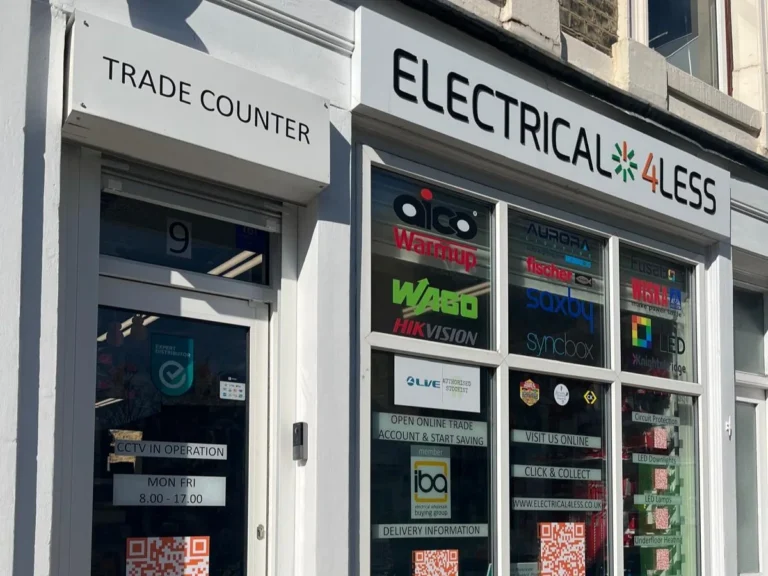
Electrical4Less Ltd is an independent electrical wholesaler based at 9 Seagrave Road, Fulham, London SW6 1RP. We supply electrical installers, contractors and online customers with consumer units, cable glands, wiring accessories and electrical installation materials.
We are members of the Independent Buying Association (IBA) and the Electrical Distributors’ Association (EDA).
In 2026, Electrical4Less was a finalist for Website of the Year at the London Chamber of Commerce SME London Business Awards and shortlisted for Best Wholesaler (1–5 Branches) at the Electrical Wholesaler Awards.
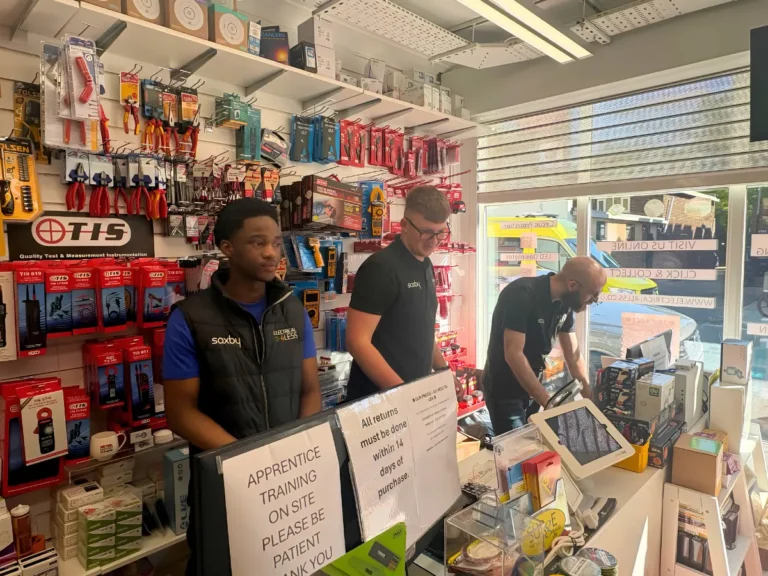
Our Fulham trade counter provides local collection of eligible orders, while our online store offers UK delivery options subject to stock availability and published terms.
Alongside cable glands, customers can explore the Consumer Units range for compatible distribution equipment and accessories.
Frequently Asked Questions About Consumer Unit Cable Glands
Final Thoughts – Choosing Consumer Unit Cable Glands
Good consumer unit cable entry design involves more than selecting a gland that fits the knockout hole. The correct arrangement depends on the cable profile, support, mechanical protection, enclosure construction and applicable electrical installation requirements.
For product information, browse the Cable Glands range at Electrical4Less and check the manufacturer’s specifications before choosing a suitable accessory for your installation.




















Leave a Reply