


Cable Gland Requirements Under BS 7671
Cable gland requirements under BS 7671 are an important consideration when selecting and installing cable entries for electrical equipment. Whether terminating steel wire armoured cable, securing meter tails, routing twin and earth cable or fitting glands to outdoor enclosures, electricians must consider mechanical protection, cable support, earthing and environmental conditions. This guide explains how cable glands contribute to a suitable installation, which product standards are relevant and why choosing a particular gland does not automatically guarantee compliance with the IET Wiring Regulations.

Cable Gland Requirements Under BS 7671 Explained
BS 7671 is the UK national standard for electrical installations. It covers requirements for the design, erection and verification of electrical installations, including the selection and installation of electrical equipment.
BS 7671 does not simply provide a universal list of approved cable glands. Instead, the installation must satisfy the relevant requirements for cable protection, electrical safety, equipment suitability and environmental conditions.
A properly selected cable gland may contribute to:
- Mechanical protection where a cable enters equipment.
- Cable retention and strain relief where required.
- Protection against dust and water ingress.
- Suitable termination of armoured or screened cables.
- Electrical continuity and protective earthing where applicable.
- Maintaining the intended protection of an enclosure.
The correct arrangement depends on the cable, enclosure, intended environment and manufacturer’s installation instructions.
Which British Standards Apply to Cable Glands?
Different standards address cable gland products and completed electrical installations. These should not be confused.
BS EN 62444 – Cable Gland Product Requirements
BS EN 62444 is a product standard covering cable glands for electrical installations. It addresses requirements and tests for relevant mechanical, electrical and environmental characteristics.
Where a manufacturer declares conformity with BS EN 62444, check the applicable product documentation to understand the gland’s tested characteristics and intended use.
BS 6121 – Traditional Armoured Cable Glands
BS 6121 is associated with traditional mechanical cable gland specifications, including gland designs used for armoured cables.
Some manufacturers reference BS 6121 alongside, or instead of, other applicable gland standards. The precise standard and product claims should be verified against the current manufacturer’s technical documentation.
BS 7671 – Electrical Installation Requirements
BS 7671 addresses the wider electrical installation rather than certifying an individual gland as compliant for every application.
A gland manufactured to a relevant product standard can still be incorrectly selected or installed.
For example, an otherwise suitable gland may fail to provide adequate cable retention if used with the wrong cable diameter or fitted contrary to the manufacturer’s instructions.
BS 7671 Amendment 4:2026 – The Current Edition
The current edition of the IET Wiring Regulations is BS 7671:2018+A4:2026, following the publication of Amendment 4 on 15 April 2026 and the withdrawal of the previous edition on 15 October 2026.
Amendment 4 includes developments relating to stationary secondary batteries, functional earthing, Power over Ethernet and medical locations, alongside other changes.
For cable gland selection, electricians must continue to consider the applicable general requirements for equipment installation, mechanical protection, electrical connections, protective conductors and external influences.
A product advertised as suitable for use in an electrical installation does not itself establish compliance with Amendment 4 or any other edition of BS 7671.
For further information, consult the IET’s current BS 7671 guidance.
Why Correct Cable Gland Selection Matters
Cable glands perform several different functions depending on their design. Some primarily protect a cable at the entry point, while others provide compression sealing, strain relief or an armour termination.
Choosing the wrong gland may result in inadequate cable retention, poor environmental sealing or unsuitable termination of the cable construction.
A suitable gland should be selected using the actual cable dimensions, rather than relying only on the nominal conductor size or gland thread designation.
For example, two cables with the same conductor cross-section may have different overall diameters because of differences in insulation, bedding, sheath and armour construction.
When selecting a gland, confirm:
- The cable construction and outside diameter.
- The gland’s permitted cable sealing range.
- The entry thread and enclosure hole size.
- Required cable retention and mechanical support.
- Relevant environmental protection.
- Any protective earthing or continuity requirements.
- The gland manufacturer’s installation instructions.

Cable Glands and Mechanical Protection
One of the main reasons for fitting a suitable cable gland, bush or grommet is to protect the cable where it passes through an enclosure opening.
Unprotected metal edges can damage a cable sheath or insulation, particularly where movement or vibration is possible.
Depending on the installation, a suitable entry arrangement may involve a cable gland, insulating bush, membrane grommet or another manufacturer-approved accessory.
It is not correct to assume that every cable entry requires a compression gland. The necessary protection and cable support depend on the actual installation conditions.
Similarly, a compression gland does not eliminate the need for appropriate cable clips, containment or other cable support.
Cable Gland IP Ratings and Environmental Protection
Ingress Protection (IP) ratings describe resistance to the entry of solid objects and water under defined test conditions.
Different cable gland designs have different protection ratings. Not every gland sold by an electrical wholesaler is IP68-rated.
IP66 Cable Glands
IP66 indicates dust-tight protection and resistance to powerful water jets under specified conditions.
This rating is commonly found on suitable outdoor gland and enclosure arrangements.
IP68 Cable Glands
IP68 indicates dust-tight protection and resistance to immersion under conditions specified by the manufacturer.
The manufacturer must define the relevant immersion test conditions. An IP68 rating should not be interpreted as unlimited underwater or underground suitability.
The completed cable-entry assembly must also be suitable. An IP68 gland does not automatically make the entire enclosure IP68.
Electricians should verify the published gland rating and ensure that cable diameter, entry seals and fitting arrangements match the manufacturer’s requirements.
Cable Glands for Meter Tails and Consumer Units
Meter tails glands are designed for particular incoming conductor arrangements and may use multi-hole inserts to accommodate specified line, neutral and protective conductor sizes.
They can help organise cable entry through a suitable opening and provide protection or retention according to the product design.
The size of the conductors, entry location and enclosure manufacturer’s instructions should be checked before selecting a gland.
Care is also required when routing alternating-current conductors through steel enclosures because unsuitable separate-entry arrangements can lead to electromagnetic heating effects.
For more information on gland selection for consumer units, see our consumer unit cable gland selection.
Do Consumer Unit Glands Need to Be Fire-Rated?
BS 7671 contains requirements relating to non-combustible consumer unit enclosures and similar switchgear assemblies in domestic premises.
However, this does not create a blanket requirement for every cable-entry gland to be made from metal or to carry a separate fire-resistance rating.
The IET explains that the relevant consumer unit provisions do not impose a general requirement for fire-rated glands or additional intumescent sealing products at every cable entry.
The enclosure and entry arrangement must still be suitable, and the consumer unit manufacturer’s instructions should be followed.
Consequently, a suitable nylon gland should not be described as automatically non-compliant merely because the consumer unit has a metal enclosure.
Refer to the IET consumer unit guidance for further explanation.
Nylon Cable Glands for Electrical Installations
Nylon cable glands are commonly used for suitable round cable entry applications.
Polyamide glands are available in different sizes and constructions, with sealing ranges designed for particular cable diameters.
Depending on the product specification, nylon glands may offer:
- Protection against cable movement at the entry point.
- Environmental sealing around compatible cable sheaths.
- Corrosion-resistant non-metallic construction.
- Options for different metric enclosure entries.
Temperature ratings, UV resistance, material characteristics and protection ratings vary by manufacturer and product.
A nylon gland must not be assumed suitable for armoured cable unless its manufacturer specifies an appropriate armour termination arrangement.
SWA Cable Glands and Armour Earthing
SWA cable glands are designed to terminate compatible steel wire armoured cable constructions.
Correct SWA termination involves more than environmental sealing. The cable armour must be appropriately clamped and any necessary electrical continuity or protective earthing arrangement must be established.
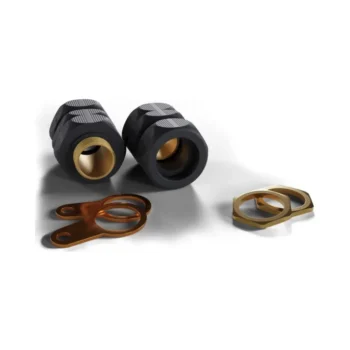
Depending on the installation and gland design, the termination may require an earth tag, earthing nut or another approved component.
Where the armour is used as a circuit protective conductor, its suitability must be established through electrical design and verification.
It is important not to assume that a gland’s metal construction automatically establishes an adequate protective conductor connection.
For detailed gland selection, review the product documentation and our SWA termination range.
CXT Brass Cable Glands for Screened Cables
CXT brass cable glands are specialist products intended for certain screened or braided cable constructions.
They are not interchangeable with every conventional SWA gland because different cable types require different clamping and continuity arrangements.
When choosing a CXT gland, check the manufacturer’s permitted cable construction, cable dimensions, screening requirements and appropriate fitting instructions.
The relevant mechanical and electrical performance depends on the particular gland and how it is installed.
Wiska ShieldGLAND and STORM Cable Glands
For certain specialist armoured cable installations, electricians may consider products such as Wiska ShieldGLAND and Tauras STORM cable glands.
These products use different construction and termination arrangements from traditional BW or CW brass glands.
Selected versions offer manufacturer-specified IP68 environmental protection, subject to the relevant test and fitting conditions.
However, higher ingress protection does not automatically establish that a product is the most appropriate gland for every cable or installation.
The cable construction, armour clamping, earthing arrangements and enclosure compatibility remain essential considerations.
Specialist glands may provide practical installation advantages, but fitting time and performance depend on the exact product and installation conditions.

Common Cable Gland Installation Mistakes
Even a correctly specified cable gland may not perform as intended if installed incorrectly.
Common mistakes include:
- Selecting a gland using the nominal cable size without checking the actual diameter.
- Using a round compression gland with an incompatible flat cable profile.
- Failing to protect the cable from sharp metal entry edges.
- Overtightening or undertightening the cable seal.
- Omitting a sealing washer or required accessory.
- Failing to provide adequate cable support outside the enclosure.
- Using an inappropriate gland for an armoured or screened cable.
- Assuming an IP68 gland makes an entire enclosure IP68.
- Failing to establish or verify necessary protective earthing continuity.
- Using gland accessories contrary to the enclosure manufacturer’s instructions.
The completed arrangement should be inspected and, where applicable, tested as part of the electrical installation verification process.
Cable Gland Selection Checklist for Electricians
Before selecting and installing a cable gland, consider the following steps:
- Identify the actual cable construction and overall dimensions.
- Check the manufacturer’s permitted gland sealing and clamping range.
- Confirm the enclosure entry thread and available fitting space.
- Determine any environmental sealing requirements.
- Check the necessary cable support and retention arrangements.
- Identify armour earthing or screening continuity requirements.
- Use the appropriate locknuts, washers and other specified accessories.
- Follow the manufacturer’s assembly instructions.
- Verify that the completed cable entry is appropriate for the intended installation.
These checks help reduce the risk of incorrect product selection and support good electrical installation practice.
Cable Gland Ranges at Electrical4Less
Electrical4Less supplies cable glands for a wide range of electrical installation applications, including domestic distribution boards, outdoor electrical equipment and specialist cable terminations.
Our main ranges include:
- Cable Glands – the main range of gland and cable-entry products.
- Meter Tails Glands – gland kits for compatible incoming conductor arrangements.
- Nylon Cable Glands – selected compression glands for round cables.
- SWA Cable Glands – products for suitable steel wire armoured cable terminations.
- CXT Brass Cable Glands – specialist products for compatible screened cable constructions.
- Wiska ShieldGLAND – selected specialist cable termination systems.
Accessories such as locknuts, earth tags and sealing washers are included with some kits and supplied separately for others. Always check the individual product listing to confirm what is included.
Bulk Cable Gland Orders and Trade Quotes
For larger installations or repeat trade requirements, Electrical4Less can help with product selection and quotations for cable glands and associated accessories.
When requesting a quotation, provide the required gland sizes, quantities, cable types and any specific brand or environmental protection requirements.
Visit Electrical4Less to explore the catalogue and contact our sales team about your requirements.
About Electrical4Less – Independent Electrical Wholesaler
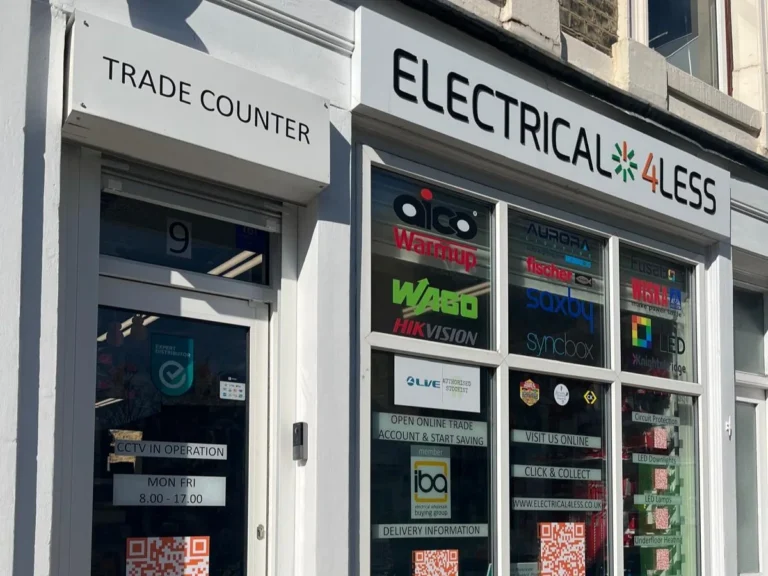
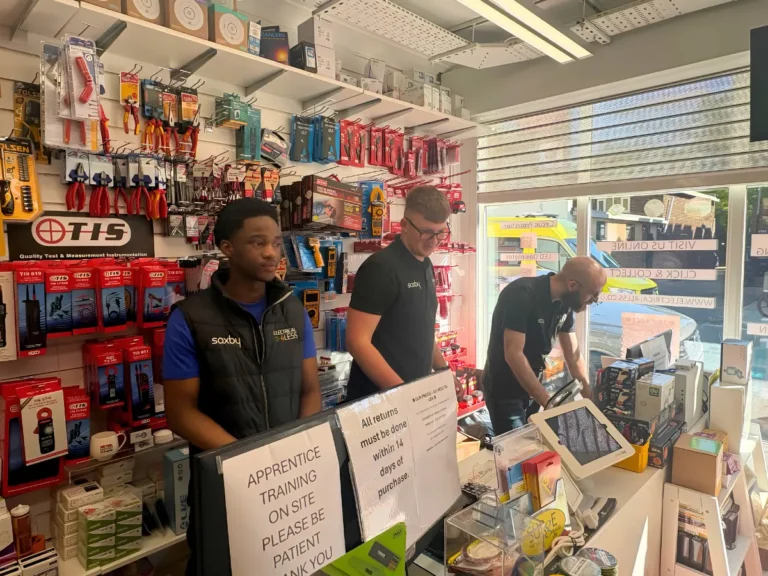
Electrical4Less Ltd is an independent electrical wholesaler based at 9 Seagrave Road, Fulham, London SW6 1RP. We supply electricians, contractors and online customers with cable glands, armoured cables, consumer units, junction boxes and electrical installation accessories.
We are members of the Independent Buying Association (IBA) and the Electrical Distributors’ Association (EDA).
In 2026, Electrical4Less was a finalist for Website of the Year at the London Chamber of Commerce SME London Business Awards and shortlisted for Best Wholesaler (1–5 Branches) at the Electrical Wholesaler Awards.
Customers can arrange collection of eligible orders from our Fulham trade counter or choose available UK delivery services, subject to stock availability and our published delivery terms.
Our online range includes specialist cable termination products as well as everyday electrical supplies for domestic, commercial and industrial work.
Frequently Asked Questions About Cable Gland Requirements Under BS 7671
Final Thoughts – Choosing Cable Glands for BS 7671 Installations
Understanding cable gland requirements under BS 7671 helps electricians make informed decisions about cable entry, mechanical protection, environmental sealing and appropriate termination arrangements.
The best gland is not necessarily the most expensive or the one with the highest IP rating. It is the product whose specifications match the cable, enclosure and intended installation conditions.
Explore our Cable Glands range for available products and consult the relevant manufacturer data before selecting a cable entry solution.
























Leave a Reply