


Live Electrical Bidirectional RCBO Explained
Live Electrical bidirectional RCBO explained: the AMR range combines residual-current protection, overload and short-circuit protection, switched-neutral operation and bidirectional capability in a compact single-module device. These features make the range worth considering for suitable modern distribution-board applications, including circuits where power may flow in either direction. This guide explains how Live Electrical AMR RCBOs work, what their specifications mean, and the important checks electricians must make before installation.
Live Electrical Bidirectional RCBO Explained – How It Works
An RCBO, or residual current circuit breaker with overcurrent protection, combines residual-current protection and overcurrent protection in one device.
It can provide protection against specified residual-current faults while also incorporating overload and short-circuit protection for the circuit.
Bidirectional capability means the protective device is designed to operate appropriately where electrical energy may flow in either direction through the device, subject to its manufacturer’s specifications and installation instructions.
This distinction has become increasingly relevant with installations incorporating solar photovoltaic systems, battery energy storage and other equipment capable of exporting electrical energy.
Not every RCBO is designed for bidirectional use. Some devices require their supply and load connections to be made in a particular orientation.
Electricians must therefore verify the protective device’s declared characteristics rather than assuming that a conventional RCBO can be connected in either direction.
Live Electrical AMR Bidirectional RCBO Range
Live Electrical’s AMR range provides compact RCBO protection with bidirectional capability and switched-neutral operation.
The manufacturer describes its AMR devices as single-module RCBOs with a double-pole switching arrangement.
According to Live Electrical’s published technical data, key characteristics of the range include:
- Single-module construction, approximately 18mm wide.
- Bidirectional operation.
- Switched-neutral arrangement.
- Type A residual-current protection.
- 6kA rated short-circuit breaking capacity.
- B-curve and C-curve tripping options.
- Different rated currents up to 40A.
- 30mA residual-current versions and selected other sensitivities.
- Compliance declared by the manufacturer with BS EN 61009-1.
Individual model specifications must be checked because the available rated currents, trip curves and residual-current sensitivities vary across the range.
For official information, consult the Live Electrical AMR technical data sheet.
What Does Switched Neutral Mean on an AMR RCBO?
The switched-neutral arrangement is an important feature of Live Electrical AMR RCBOs.
In addition to switching the line conductor, the device opens its neutral switching contact when the RCBO operates, in accordance with its specified construction.
This can provide useful circuit separation and is particularly relevant when considering the switching of live conductors in generating-set applications.
However, switched neutral should not be confused with independently protected neutral or a guarantee that the device is suitable for every isolation application.
The complete arrangement must satisfy the applicable switching, isolation and protective-device requirements.
Type A RCBO vs B-Curve and C-Curve – What Is the Difference?
These designations describe different electrical characteristics and should not be confused.
Type A Residual-Current Protection
Type A describes the residual-current operating characteristic. A Type A RCBO is designed to respond to specified alternating residual currents and pulsating DC residual currents.
It is not equivalent to a Type B residual-current device and does not automatically provide the residual-current protection required by every inverter or variable-speed electronic system.
B-Curve and C-Curve Overcurrent Characteristics
B-curve and C-curve describe the magnetic overcurrent tripping characteristics of the device.
Selection depends on the load, prospective fault current, circuit characteristics and the ability of the protective device to achieve the required disconnection performance.
A C-curve device should not be selected simply because an installation contains an inverter or motor. The circuit design must demonstrate that the chosen characteristic is suitable.
Therefore, a Live Electrical AMR RCBO may be described as Type A, B-curve or Type A, C-curve. These descriptions are not contradictory because they relate to different protection functions.
Live Electrical AMR Product Codes Explained
Live Electrical offers several AMR devices with different current ratings and trip characteristics. Examples include:
| Product Code | Current Rating | Trip Curve | Residual-Current Type | Breaking Capacity |
|---|---|---|---|---|
| AMR106B-030 | 6A | B | Type A, 30mA | 6kA |
| AMR116B-030 | 16A | B | Type A, 30mA | 6kA |
| AMR120B-030 | 20A | B | Type A, 30mA | 6kA |
| AMR132B-030 | 32A | B | Type A, 30mA | 6kA |
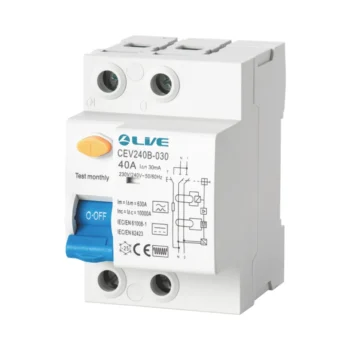
| AMR140B-030 | 40A | B | Type A, 30mA | 6kA |
| AMR116C-030 | 16A | C | Type A, 30mA | 6kA |
| AMR132C-030 | 32A | C | Type A, 30mA | 6kA |
| AMR140C-030 | 40A | C | Type A, 30mA | 6kA |
These examples reflect manufacturer-listed AMR variants, not a recommendation to use a particular rating on a particular circuit.
Electrical4Less also lists selected 100mA AMR versions, including AMR132B-100 and AMR140B-100. Their residual-current sensitivity differs from the 30mA versions, so they must not be treated as interchangeable where 30mA additional protection is required.
Browse the current Live Electrical RCBO range to compare available ratings and order the suitable product.
Bidirectional RCBOs and BS 7671 Amendment 3:2024
Amendment 3:2024 introduced Regulation 530.3.201, requiring the selection and erection of protective equipment to take account of the appropriate use of either unidirectional or bidirectional protective devices.
This was an important clarification as electrical installations increasingly incorporated generation and energy storage systems.
However, Amendment 3 did not establish a simple universal rule that every solar installation, battery or EV charger must use a bidirectional RCBO.
The need for a bidirectional device depends on the circuit arrangement, direction of possible energy flow, protective-device design and the manufacturer’s requirements.
A unidirectional device should not be used where its specified supply and load orientation would be incompatible with the intended electrical arrangement.
The IET’s technical article on bidirectional protective devices explains the distinction and relevant installation considerations.
BS 7671 Amendment 4:2026 – Current Requirements
BS 7671:2018+A4:2026 is the current edition of the IET Wiring Regulations following publication on 15 April 2026 and withdrawal of the previous edition on 15 October 2026.
Amendment 4 includes further developments relevant to generating sets and energy storage systems, including changes within Section 551 and a new chapter addressing stationary secondary batteries.
For installations where generating equipment may operate in parallel with another source, the selection and arrangement of protective devices requires particular care.
The relevant provisions address the suitability of protective devices where energy flow may be bidirectional and the connection arrangements involving residual-current devices.
Electricians must consider the published Amendment 4 requirements alongside equipment manufacturer instructions, circuit design and the intended operating modes.
The use of a bidirectional RCBO is only one part of that assessment and does not guarantee compliance of the complete installation.
See the IET’s information on the current BS 7671 edition.
Where Might a Bidirectional RCBO Be Required?
The appropriate application depends on whether the device may experience electrical supply or energy flow from more than one direction.
Solar PV Systems
Solar photovoltaic inverters can introduce electrical generation into an installation. Some arrangements may require protective devices suitable for reverse energy flow.
Where an RCD or RCBO is required on a PV inverter circuit, its residual-current type, switching arrangement and compatibility with the inverter must be determined from the relevant requirements and manufacturer instructions.
Type A protection is not automatically suitable for every PV inverter. Depending on the equipment and arrangement, Type B residual-current protection or another specified protective solution may be necessary.
Battery Energy Storage Systems
Battery energy storage systems can operate in different modes, including charging from the installation and supplying energy back into it.
These arrangements require careful protective-device selection, including the direction of possible power flow and the residual-current protection specified by the equipment manufacturer.
A bidirectional RCBO may be appropriate in a correctly designed circuit, but its current rating, residual-current type and installation compatibility must still be verified.
Vehicle-to-Grid and Vehicle-to-Home Systems
Some electric vehicle systems can export power to a property or electricity network through suitable bidirectional charging equipment.
These installations are different from conventional one-way EV charging circuits and require protective-device selection appropriate to the charging equipment and possible operating modes.
Not every EV charge point needs a bidirectional RCBO. An ordinary unidirectional charger must be assessed according to its own installation and protective-device requirements.
Is a Type A Bidirectional RCBO Suitable for Every Solar or EV Installation?
No. Bidirectional operation and residual-current sensitivity are separate technical characteristics.
A bidirectional Type A RCBO may be suitable for an installation where its residual-current characteristics, current rating, breaking capacity and switching arrangement meet the requirements.
However, electronic power converters can introduce residual-current conditions that require additional consideration.
Where the installation or equipment requires Type B residual-current protection, selecting a bidirectional Type A RCBO does not by itself satisfy that requirement.
Similarly, a 100mA RCBO should not be substituted for a 30mA device where 30mA additional protection is necessary.
The protective arrangement must be based on the applicable BS 7671 requirements and the actual equipment documentation.
AMR vs RNC – Understanding Live Electrical Compatibility
Live Electrical manufactures more than one family of bidirectional RCBOs. The AMR and RNC ranges should not be treated as identical or universally interchangeable.
AMR Compact RCBOs
AMR devices are compact single-module Type A RCBOs with switched-neutral functionality and a manufacturer-declared 6kA breaking capacity.
They are designed for compatible distribution arrangements, subject to the relevant assembly and manufacturer instructions.
RNC Double-Pole RCBOs for SRN Boards
The RNC range includes single-module double-pole Type A bidirectional RCBOs intended for Live Electrical’s compatible SRN consumer unit system.
These devices must be selected with particular attention to the busbar and enclosure assembly for which they are intended.
Do not assume that an AMR device can replace an RNC device, or that a standard RCBO will fit and operate correctly in an SRN board.
Always confirm assembly compatibility with Live Electrical’s relevant documentation before changing protective devices.
What to Check Before Buying a Live Electrical Bidirectional RCBO
Before selecting an AMR or another Live Electrical RCBO, an installer should verify the following:
- Confirm whether the electrical arrangement requires a bidirectional protective device.
- Check the consumer unit or distribution-board manufacturer’s approved device compatibility.
- Choose the correct current rating for the circuit design.
- Determine whether B-curve or C-curve operation is appropriate.
- Verify the residual-current type, including any inverter-related DC residual-current requirements.
- Select the correct residual-current sensitivity, such as 30mA where required for additional protection.
- Confirm the breaking capacity is suitable for the prospective fault current and protective arrangement.
- Check any requirements for switching the neutral conductor.
- Follow the manufacturer’s connection, tightening and testing instructions.
The manufacturer’s product code provides useful identification but does not replace the need for electrical design and verification.
Why Choose Live Electrical AMR RCBOs?
For suitable installations, Live Electrical’s AMR range offers a combination of practical features in a compact format.
- Single-module design helps accommodate individual circuit protection within compatible boards.
- Switched-neutral functionality is integrated into the device.
- Bidirectional capability provides an option for installations where reverse power flow must be considered.
- Type A residual-current protection is available in multiple current ratings.
- B-curve and C-curve options provide flexibility for correctly designed circuits.
- 6kA breaking capacity provides a defined performance characteristic for product selection.
These features can make AMR devices an attractive option, but the required protective-device characteristics must always determine the final selection.
Live Electrical Bidirectional RCBOs at Electrical4Less
Electrical4Less supplies Live Electrical RCBOs for professional electrical installers and customers purchasing suitable circuit protection equipment online.
Our Live RCBO category includes selected AMR bidirectional devices, conventional RCBO ranges and specialist RNC products for compatible SRN consumer units.
Customers can compare individual model codes, circuit ratings, tripping curves and residual-current specifications before ordering.
For a wider choice of brands, browse the RCBO circuit breakers category.
The following product selection is retained from the original article. Check each product page for its current specification, availability and compatibility.
-
 Live Electrical | AMR116B-030 | 6kA 30mA | Type A B Curve | Bi-Directional RCBO | 16A
£8.22
-
Live Electrical | AMR120B-030 | 6kA 30mA | Type A B Curve | Bi-Directional RCBO | 20A
£8.22
-
Live Electrical | AMR132B-030 | 6kA 30mA | Type A B Curve | Bi-Directional RCBO | 32A
£8.22
-
Live Electrical | AMR140B-030 | 6kA 30mA | Type A B Curve | Bi-Directional RCBO | 40A
£8.22
-
Live Electrical | AMR106B-030 | 6kA 30mA | Type A B Curve | Bi-Directional RCBO | 6A
£8.22
-
Live Electrical | AMR110B-030 | 6kA 30mA | Type A B Curve | Bi-Directional RCBO | 10A
£8.22


About Electrical4Less – Live Electrical Distributor
Electrical4Less Ltd is an independent electrical wholesaler based at 9 Seagrave Road, Fulham, London SW6 1RP. We supply electrical contractors, installers and online customers with consumer units, RCBOs, distribution equipment and electrical installation accessories.
We are members of the Independent Buying Association (IBA) and the Electrical Distributors’ Association (EDA).
In 2026, Electrical4Less was a finalist for Website of the Year at the London Chamber of Commerce SME London Business Awards and shortlisted for Best Wholesaler (1–5 Branches) at the Electrical Wholesaler Awards.
We offer online ordering with UK delivery options and collection of eligible orders from our Fulham trade counter, subject to current stock and delivery terms.
Our team works closely with Live Electrical to develop and supply the manufacturer’s products to the UK electrical trade.
Frequently Asked Questions About Live Electrical Bidirectional RCBOs
Technical References
- Live Electrical – AMR RCBO Technical Data Sheet.
- IET – Bidirectional Protective Devices.
- IET – Current BS 7671 Regulations.
- Live Electrical – Manufacturer Website.
Final Thoughts – Choosing Live Electrical Bidirectional RCBOs
Live Electrical’s AMR bidirectional RCBO range provides compact Type A residual-current and overcurrent protection with switched-neutral functionality. Its single-module design and different current ratings make it worth considering where the manufacturer’s specifications and the electrical installation requirements are satisfied.
Bidirectional capability is an important consideration for modern generating and energy-storage installations, but it does not replace correct circuit design, residual-current type selection or approved consumer unit compatibility.
Browse our Live Electrical RCBO range to compare models and buy suitable products online from Electrical4Less.



























Leave a Reply