



Series wiring LED marker lights is very different from wiring standard 12V or 24V lighting.
Many outdoor marker lights are designed specifically for series wiring and must be powered by a constant current LED driver.
Failing to follow the manufacturer’s instructions — especially wiring series-rated lights in parallel — can result in permanent LED damage.
What Does Series Wiring Mean for LED Marker Lights?
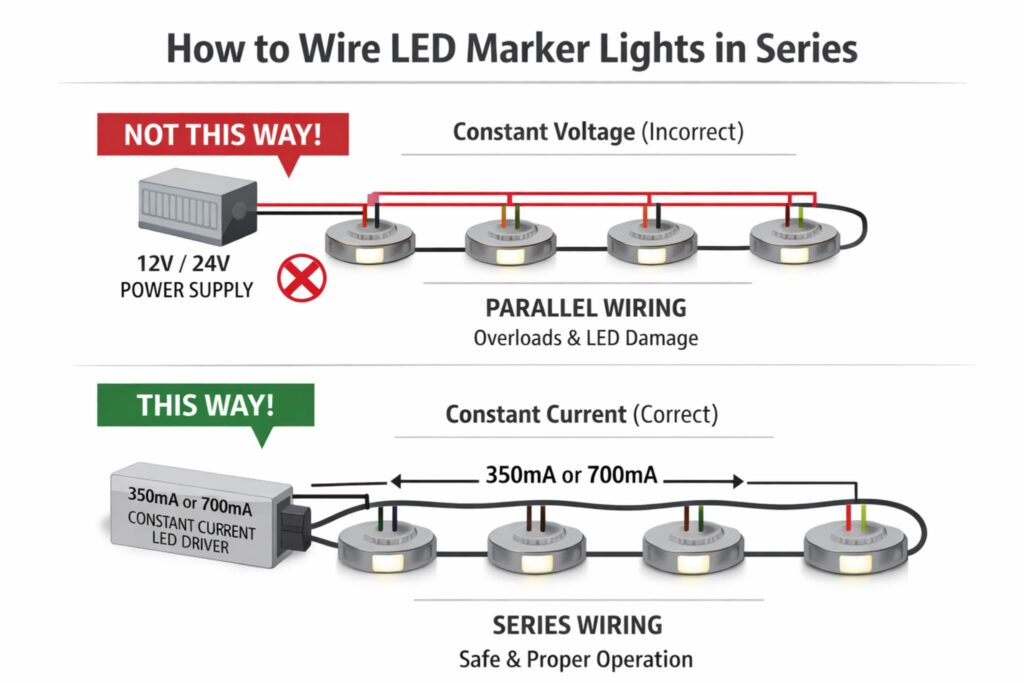
In a series wiring LED marker lights installation, each light is connected end-to-end, forming a single electrical path.
In this type of circuit:
- The same current flows through every fitting
- The driver controls the current (typically 350mA or 700mA)
- The voltage is shared across all lights
If one light fails or is disconnected, the circuit opens and all lights turn off. This is normal behaviour for series wiring.
Why Series Wiring LED Marker Lights Require Constant Current Drivers
Series-wired marker lights are current-controlled, not voltage-controlled.
They must be powered by a constant current LED driver, not a 12V or 24V constant voltage supply.
Common ratings include:
- 350mA – lower output marker and step lights
- 700mA – higher output wall and marker lights
The driver automatically adjusts its output voltage to suit the total load of the series circuit.
⚠️ Important Warning: Parallel Wiring Will Damage Series Lights
If series wiring LED marker lights are connected in parallel:
- The LEDs receive uncontrolled current
- Internal overheating occurs
- Brightness becomes unstable
- LEDs may fail instantly or degrade over time
Even if the lights appear to work initially, irreversible internal damage may already be happening.
This type of damage is usually not covered by warranty.
How to Wire LED Marker Lights in Series (Correct Method)
The correct method for series wiring LED marker lights is:
- Connect the constant current driver output to the first light
- Link each light out to in, end-to-end
- Connect the final light back to the driver
- Use only identical fittings on the same circuit
Always confirm the total forward voltage of all lights falls within the driver’s voltage range.
Common Installer Mistakes to Avoid
❌ Assuming all low-voltage lights can be wired in parallel
❌ Using a 12V or 24V constant voltage power supply
❌ Mixing 350mA and 700mA fittings on one circuit
❌ Adding extra lights without recalculating total voltage
Marker lights may look similar externally, but their electrical requirements can be very different.
Best Practice Before Installation
Before installing any marker lights:
✔️ Read the manufacturer’s instructions
✔️ Confirm whether series wiring is required
✔️ Match the correct constant current driver
✔️ Verify the current rating (350mA or 700mA)
✔️ Calculate total circuit voltage
Never assume wiring method based on appearance alone.
FAQs – Series Wiring LED Marker Lights
Overheat
Flicker or dim unevenly
Fail immediately or prematurely
Even short-term testing can cause long-term damage.




































Series Wiring LED Marker Lights – Why Instructions Matter