

Table of Contents
Amendment 4 BS 7671
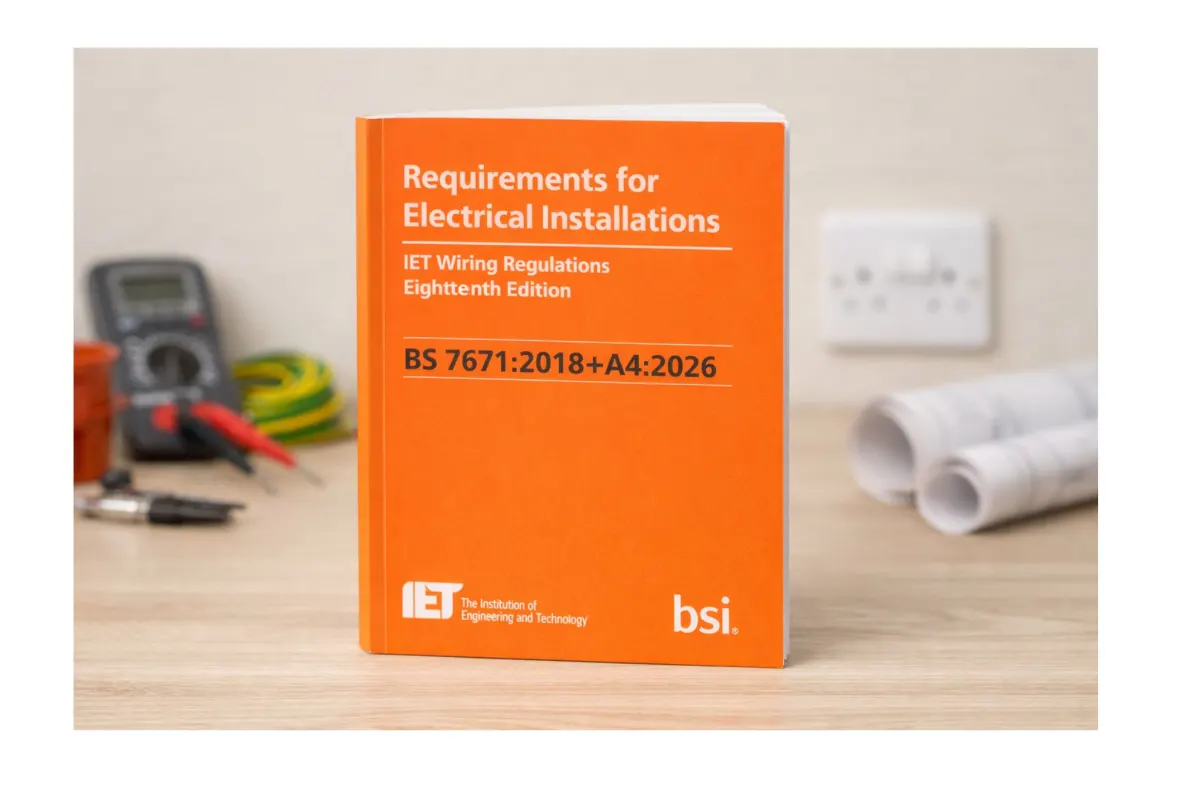
Amendment 4 BS 7671 is a major update to the Eighteenth Edition of the IET Wiring Regulations and represents the next stage in the ongoing development of the UK’s national standard for electrical installations.
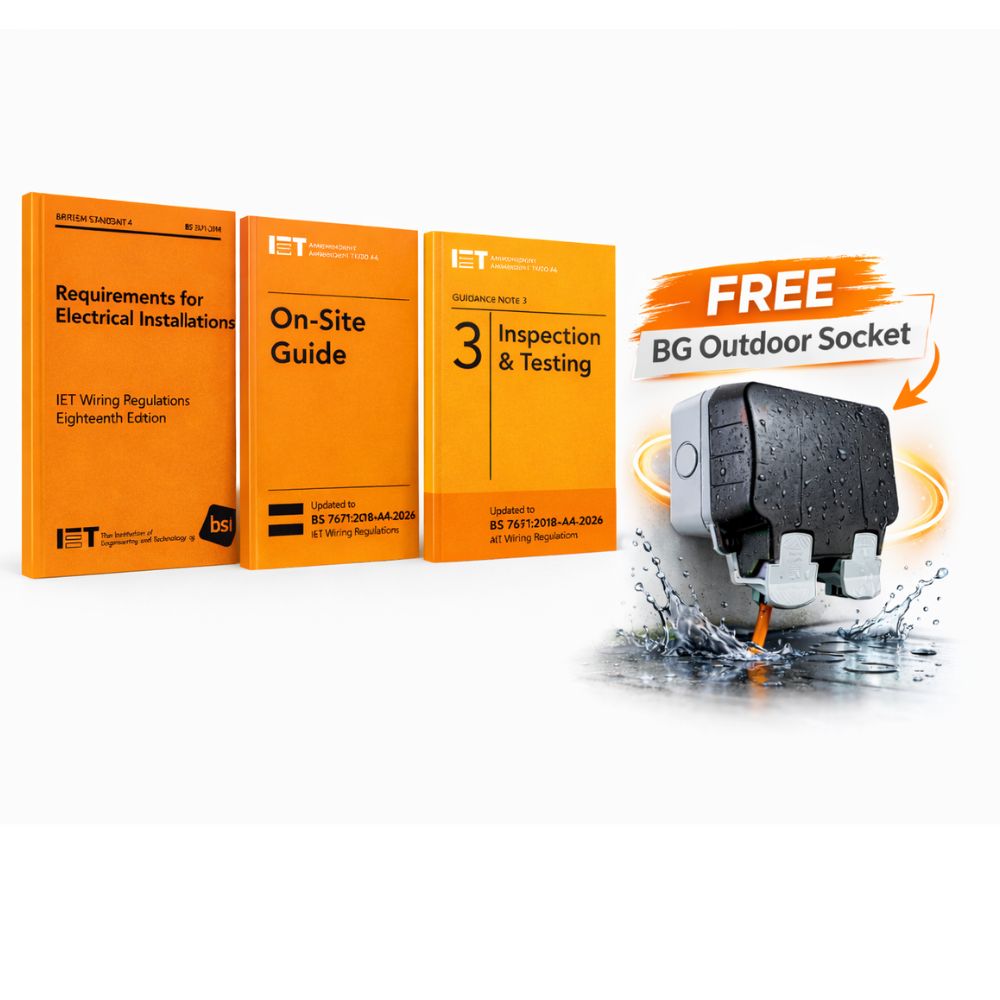
Get More with Amendment 4
Pre-order the 3-book Amendment 4 bundle and receive a
FREE BG Outdoor Socket!
Everything you need for the latest BS 7671 update — plus a practical outdoor essential at no extra cost.
Limited-time bundle offer.
Formally titled BS 7671:2018 + A4:2026, this amendment consolidates all previous updates into a single, complete publication. It reflects how electrical installations are evolving as new technologies, energy systems, and methods of use become more common across domestic, commercial, and industrial environments.
This consolidated edition is widely referred to as “the Orange Book.”
What Is BS 7671 and Why It Matters
BS 7671, commonly known as the IET Wiring Regulations, is the UK national standard that sets out requirements for electrical installations. It provides a consistent framework for ensuring installations are designed and installed to recognised safety and performance standards.
BS 7671 applies to:
- All low-voltage electrical installations
- New installations
- Additions and alterations to existing installations
- Periodic inspection and testing
The Wiring Regulations are essential for anyone involved in:
- Design
- Installation
- Inspection and testing
- Certification
- Maintenance of electrical installations
BS 7671 is jointly published by the
Institution of Engineering and Technology (IET) and the
British Standards Institution (BSI).
The technical content is developed by the national Wiring Regulations committee JPEL/64, ensuring the standard reflects both UK-specific requirements and international developments.
How We Got Here: The Evolution of the 18th Edition
The Eighteenth Edition of BS 7671 was first published in 2018. Since then, it has been updated through a series of amendments to reflect new technologies, installation practices, and developing standards.
BS 7671:2018 – Original 18th Edition (2018)
The original 18th Edition was published in July 2018. It forms the base document for all subsequent amendments.
The physical publication featured a blue-toned cover design, but it was not formally identified or named by colour.
Amendment 1:2020
BS 7671:2018 + A1:2020 was issued as a standalone amendment. It did not replace the main book and did not introduce a new consolidated edition. Amendment 1 was intended to be used alongside the original 18th Edition and continued to rely on the same base publication and cover design.
Amendment 2:2022
BS 7671:2018 + A2:2022 introduced further updates across the Regulations. Like Amendment 1, it was not a full consolidation and did not introduce a new or distinct cover colour. Electricians were required to reference it in conjunction with BS 7671:2018.
Amendment 3:2024
BS 7671:2018 + A3:2024 was issued as a standalone publication and is commonly recognised by its brown cover. This marked the first visually distinct standalone amendment for the 18th Edition and addressed further developments in installation practices. It remains in use until its withdrawal following Amendment 4.
Amendment 4:2026 – Full Consolidation
BS 7671:2018 + A4:2026 is published on 15 April 2026 and represents the second full consolidated amendment to the 18th Edition. It incorporates:
- BS 7671:2018
- Amendment 1:2020
- Amendment 2:2022
- Amendment 3:2024
This consolidated publication is issued with an orange cover and is commonly referred to within the industry as the Orange Book.

What’s New in Amendment 4 BS 7671 (Confirmed Changes Only)
Amendment 4 introduces new sections and revisions that reflect the growing complexity of modern electrical installations. The following changes are confirmed by official IET, BSI, and NAPIT statements.
Stationary Secondary Batteries
Amendment 4 introduces a new chapter on stationary secondary batteries where the purpose is:
- Electrical energy storage
- Supplying electrical installations
This change reflects the increasing use of battery energy storage systems as part of electrical installations, including integration with renewable energy systems. The inclusion establishes formal requirements within BS 7671 for this type of equipment.
Functional Earthing and Equipotential Bonding for ICT Systems
A new section has been introduced covering:
- Functional earthing
- Functional equipotential bonding
These requirements apply specifically to information and communication technology (ICT) equipment and systems. The section recognises that some systems require earthing and bonding arrangements for functional performance in addition to safety.
Power over Ethernet (PoE)
Amendment 4 includes a new dedicated section on Power over Ethernet (PoE).
This reflects:
- The growing use of PoE for lighting, data networks, and building services
- The need for Wiring Regulations to address higher power levels now commonly delivered via Ethernet cabling
The inclusion ensures PoE installations are formally recognised within BS 7671.
Section 710 – Medical Locations
Section 710 (Medical Locations) has undergone a major revision.
Confirmed changes include:
- Updated requirements reflecting current medical installation practices
- The inclusion of a schedule of test results for recording the resistance of supplementary protective equipotential bonding conductors
This reinforces the importance of testing and documentation in healthcare environments.
Implementation and Transition Period
- Publication date: 15 April 2026
- Amendment 4 can be implemented immediately from the publication date
- The previous version, BS 7671:2018 + A2:2022 + A3:2024, will be withdrawn six months later
After withdrawal, BS 7671:2018 + A4:2026 (the Orange Book) becomes the primary reference for compliance.
What Amendment 4 BS 7671 Applies To
According to industry guidance, Amendment 4 will form the UK national standard for:
- All new low-voltage electrical installations
- Additions and alterations to existing installations
- Periodic inspection and testing of existing installations
Industry and Standards Body Statements
Members of the JPEL/64 committee are not permitted to release further technical detail before publication.
Mark Coles, Head of Technical Regulations at the IET, has stated that Amendment 4 continues the focus on embracing new technologies and that the inclusion of stationary secondary batteries represents an important step forward.
Sebastiaan van Dort, Director of Energy & Sustainability at BSI, has highlighted that BS 7671 underpins safe, modern electrical infrastructure and supports the UK’s transition towards clean energy and electrification.
NAPIT Guidance and Industry Support
NAPIT has welcomed the publication of Amendment 4 and encourages electrical professionals to familiarise themselves with the changes once released.
NAPIT is supporting members through:
- Updated NAPIT and IET publications
- CPD webinars explaining Amendment 4 and its impact
- Technical roadshows and masterclasses across the UK
Official sources:
- NAPIT statement:
https://www.napit.org.uk/news/NAPIT-Welcomes-the-Press-Release-Statement-on-the-Amendment-4-2026-to-BS-7671-2018-IET-Wiring-Regulations-from-IET-BSI/ - IET Amendment 4 updates:
https://electrical.theiet.org/amendment-4-updates-to-18th-edition
Why Amendment 4 BS 7671 Is Important
BS 7671 underpins:
- Electrical safety
- Professional competence
- Consistent inspection and certification
- Confidence when working with new and developing technologies
Amendment 4 BS 7671 simplifies compliance by consolidating all previous amendments into a single document while ensuring the Wiring Regulations continue to reflect modern electrical installations.
Frequently Asked Questions – Amendment 4 BS 7671 (Compact)
What is Amendment 4 BS 7671?
Amendment 4 BS 7671 is the latest update to the 18th Edition of the IET Wiring Regulations. Officially titled BS 7671:2018+A4:2026, it is a fully consolidated edition that brings together the original 2018 regulations and all subsequent amendments into a single document, commonly known as the Orange Book.
When is Amendment 4 BS 7671 published?
Amendment 4 BS 7671 is published on 15 April 2026 and can be implemented immediately from that date for electrical installation work.
Is Amendment 4 BS 7671 mandatory?
BS 7671 is not statutory law, but it is the recognised UK national standard for electrical installations and is widely used to demonstrate compliance with the Electricity at Work Regulations and industry best practice.
When do electricians have to start using the Orange Book?
The Orange Book can be used from 15 April 2026, and the previous edition, BS 7671:2018+A2:2022+A3:2024, will be withdrawn six months later, after which Amendment 4 becomes the primary reference.
What does “consolidated edition” mean?
A consolidated edition combines the original 18th Edition and Amendments 1, 2, and 3 into one complete publication, removing the need to cross-reference multiple documents.
What colour is Amendment 4 BS 7671?
Amendment 4 BS 7671 is commonly referred to as the Orange Book, following the established colour convention for Wiring Regulations editions and amendments.
What are the main confirmed changes in Amendment 4?
Confirmed changes include a new chapter on stationary secondary batteries for energy storage and supply, a new section on functional earthing and equipotential bonding for ICT systems, a new section on Power over Ethernet (PoE), a major revision of Section 710 Medical Locations, and the inclusion of a schedule of test results for supplementary protective equipotential bonding conductors.
Does Amendment 4 introduce requirements for battery storage systems?
Yes, Amendment 4 introduces a dedicated chapter covering stationary secondary batteries used for electrical energy storage and supply of installations, reflecting the increasing use of battery energy storage systems.
Are EV charging requirements changed in Amendment 4?
No additional EV charging changes have been confirmed as part of Amendment 4; most EV-related requirements were introduced under Amendment 1:2020.
What is new about Power over Ethernet (PoE)?
Amendment 4 includes a dedicated section on Power over Ethernet, recognising higher power levels and the wider use of PoE for lighting, data, and building services.
Why has Section 710 Medical Locations been revised?
Section 710 has been revised to reflect current medical installation practices and includes improved guidance on testing and documentation, including a schedule for recording supplementary protective equipotential bonding resistance.
Does Amendment 4 affect EICRs and inspection work?
Yes, once in force, Amendment 4 BS 7671 applies to periodic inspection and testing, including EICRs, with inspectors assessing installations against the edition in force while applying professional judgement to older installations.
Are existing installations automatically non-compliant?
No, installations designed to earlier editions of BS 7671 are not automatically unsafe; compliance is assessed based on the standards in force at the time of installation and professional judgement during inspection.
Who is responsible for writing BS 7671?
BS 7671 is developed by the national Wiring Regulations committee JPEL/64 and jointly published by the Institution of Engineering and Technology and the British Standards Institution.
Summary
- Amendment 4 BS 7671 is a fully consolidated update to the 18th Edition
- Published 15 April 2026
- Introduces confirmed new sections on:
- Stationary secondary batteries
- ICT functional earthing
- Power over Ethernet
- Includes a major revision of Section 710 Medical Locations
- Becomes the primary reference after the withdrawal of previous editions
Connect With Electrical4Less on Social Media
Follow Electrical4Less for clear, practical updates on BS 7671 Wiring Regulations, electrical safety standards, and guidance for UK electricians and contractors:
- Electrical4Less on Instagram – installation insights, product updates, and industry news
- Electrical4Less on Facebook – regulation updates, announcements, and community discussions
- Electrical4Less on YouTube – technical explainers, Wiring Regulations guidance, and video content
We share updates on BS 7671 changes, installation guidance, product standards, and technical insights designed to support electricians, inspectors, and contractors working to current UK regulations.




























Amendment 4 BS 7671: Full Guide to the 18th Edition Wiring Regulations Update