
Table of Contents
Regulations, History, EICR Codes, Landlord Guidance & the Full Truth
Few questions in domestic electrical safety generate as much confusion, disagreement, and unnecessary cost as this one:
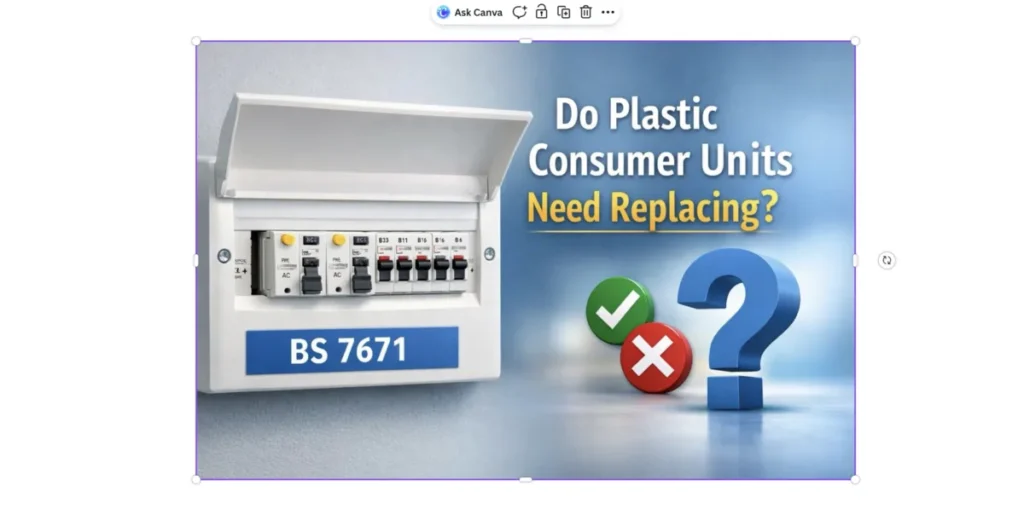
Do plastic consumer units need replacing?
For homeowners, the advice often sounds contradictory.
For landlords, the consequences can feel expensive and urgent.
For electricians, the topic regularly leads to disputes over EICR coding.
Some people are told replacement is mandatory.
Others are advised to “leave it alone.”
Some inspection reports mark plastic consumer units as C2 (Potentially Dangerous) with little explanation.
The truth is far more balanced.
When BS 7671 is applied correctly, when NAPIT Codebreakers and Best Practice Guide 4 are followed, and when installations are assessed on condition and risk rather than age or material, the answer to do plastic consumer units need replacing becomes clear, consistent, and defensible.
This in-depth guide explains do plastic consumer units need replacing using:
- UK electrical history and regulatory context
- Real-world installer experience
- Multiple BS 7671 regulation references
- EICR coding principles
- NAPIT Codebreakers logic
- Practical advice for landlords and homeowners
Do Plastic Consumer Units Need Replacing? – The Short Answer
Let’s be absolutely clear from the outset:
Plastic consumer units do NOT automatically need replacing.
Under BS 7671, whether plastic consumer units need replacing depends on:
- Whether they complied with the regulations at the time of installation
- Their current physical condition
- Evidence of overheating, deterioration, or fire risk
- Their suitability for continued service
The enclosure being plastic, on its own, is never a sufficient reason for replacement.
A Brief History of Consumer Units in the UK
To properly answer do plastic consumer units need replacing, it is essential to understand how domestic electrical installations evolved in the UK.
For many decades, plastic consumer units were the accepted and standard solution in domestic properties.
They were:
- Designed in line with earlier editions of BS 7671
- Installed legally and professionally across millions of homes
- Accepted by insurers, local authorities, and certification bodies
At the time, there was:
- No requirement for metal enclosures
- No regulatory concern about plastic as an enclosure material
- No suggestion that compliant plastic consumer units were unsafe
This context matters. Regulations evolve to improve safety, but that does not mean older compliant installations are suddenly dangerous.
What the Market Was Really Like Before Metal Consumer Units
In the years leading up to 2015, the consumer unit market changed — and not for the better.
Many experienced electricians observed a decline in the quality of some consumer units, particularly at the lower end of the market.
Cheap Plastic Consumer Units Flooded the Market
Common problems included:
- Very thin plastic walls with little rigidity
- Flexible or poorly supported back plates
- Inconsistent moulding tolerances
- Enclosures that distorted when fixed to uneven surfaces
In real installations, this often meant:
- Fixing screws caused twisting or bowing
- Once fully populated with breakers and wiring, the enclosure changed shape
- Lids became difficult to align or secure properly
- Cable tension placed stress on terminals and devices
These issues could lead to:
- Reduced internal clearances
- Increased mechanical stress
- Less predictable heat dissipation
The problem was not plastic itself, but poor enclosure design and cost-cutting.
Why the Introduction of Metal Consumer Units Was the Right Decision
Against this backdrop, the introduction of metal consumer units was entirely justified.
Fire investigations and industry reviews identified that, in certain failure scenarios, faults inside consumer units — such as:
- Loose connections
- Overheating terminals
- Arcing at terminations
could lead to fire spread beyond the enclosure.
In some cases, plastic enclosures contributed to the spread of fire, particularly where the enclosure quality was poor or where the unit was installed in higher-risk locations, such as under stairs.
What Metal Consumer Units Improved
Metal consumer units offered clear advantages:
- Far greater structural rigidity
- Improved resistance to mechanical stress during installation
- Better containment of sparks and heat in fault conditions
- More consistent alignment and enclosure integrity
This change raised minimum manufacturing standards and reduced enclosure-related fire risk in new and replacement installations.
Crucially – This Was NOT an Admission of Widespread Unsafety
Just as importantly, the introduction of metal consumer units was not an admission that existing plastic consumer units were unsafe.
This is demonstrated by:
- The non-retrospective nature of BS 7671
- The limited scope of the regulation introduced
- Subsequent guidance from industry bodies
Had plastic consumer units been deemed inherently unsafe, regulations would have required their replacement. They do not.
When Were Metal Consumer Units Introduced?
Metal consumer units became a requirement with BS 7671 (17th Edition) Amendment 3:
- Published: July 2015
- Came into effect: January 2016
This amendment introduced Regulation 421.1.201.
Regulation 421.1.201 Explained Properly
Regulation 421.1.201 – Protection Against Fire
Consumer units and similar switchgear assemblies in domestic premises must be manufactured from, or enclosed in, non-combustible material.
Scope of the Regulation
✔ Applies to new installations
✔ Applies to replacement consumer units
What the Regulation Does NOT Do
❌ It is not retrospective
❌ It does not require existing plastic consumer units to be replaced
This distinction is critical when answering do plastic consumer units need replacing.
The Regulation That Ends the Debate
Regulation 120.3 (BS 7671) states that installations complying with earlier editions of the Wiring Regulations may continue to be used provided they are safe for continued service.
This single regulation underpins:
- Correct EICR coding
- Non-retrospective enforcement
- Balanced inspection decisions
Safety is assessed on condition and risk, not age or materials.
EICRs: Safety Assessment, Not Modernisation
An Electrical Installation Condition Report (EICR) is designed to answer one question:
Is the installation safe for continued use?
It does not exist to:
- Enforce the latest design standards retrospectively
- Require upgrades simply because regulations have evolved
This is why an EICR does not automatically answer “do plastic consumer units need replacing” with a yes.
NAPIT Codebreakers: The Accepted Reference
NAPIT Codebreakers provides scenario-based guidance linking inspection findings to BS 7671 and correct EICR codes.
It is widely relied upon by:
- Certification bodies
- Scheme assessors
- Local authorities
- Inspectors and expert witnesses
Reference source: NAPIT Codebreakers
Plastic Consumer Units – Correct Coding (NAPIT Codebreakers)
Scenario 1
Plastic consumer unit
No thermal damage
Not in the sole means of escape
➡️ No Code
This scenario does not justify a departure.
Plastic consumer units do not need replacing here.
Scenario 2
Plastic consumer unit
No thermal damage
Located in the sole means of escape
➡️ C3 – Improvement Recommended
An advisory note may be appropriate, but location alone does not create danger.
Scenario 3
Plastic consumer unit
Thermal damage present (any location)
➡️ C2 – Potentially Dangerous
Here, plastic consumer units do need replacing, regardless of location, due to evidence of risk.
The Core Principle
Plastic ≠ dangerous
Damage = dangerous
Why Plastic Consumer Units Often Attract C3 Observations
Plastic consumer units often reflect the era of installation.
That era commonly included:
- Type AC RCDs
- Lower-rated dual RCD arrangements
- Design assumptions based on lower electrical demand
These features are not automatically unsafe, but they may no longer reflect modern expectations.
Dual RCD Ratings (63A or 80A) – With BS 7671 References
Many older plastic consumer units contain:
- 2 × 63A RCDs
- 2 × 80A RCDs
At the time, this complied with BS 7671.
EICR Assessment
- No signs of overheating or overload → C3
- Evidence of thermal stress → C2
The rating alone does not determine safety — condition does.
Type AC RCDs – With BS 7671 References
Type AC RCDs were compliant when installed.
Modern loads may introduce DC components, which is why Type A devices are now preferred.
- No DC-producing equipment → C3
- EV, PV, or battery systems present → Further assessment required
This does not automatically mean plastic consumer units need replacing.
Why Inspectors Often Record C3 (Not C2)
EICRs distinguish between:
- Immediate danger
- Safe but dated installations
A C2 requires evidence of increased risk, not simply age or design.
“It’s Been Fine for Years – Why Change Anything Now?”
A common question homeowners ask is:
“It’s been fine for years — why do I need to change anything now?”
A helpful comparison is an elevator (lift).
A lift does not rely on its safety brakes during normal operation. They may never engage for decades. But if something goes wrong, those brakes are there to prevent a serious accident.
Modern consumer units and protective devices work the same way.
- You hope RCDs, RCBOs, and fire-resistant enclosures never need to operate
- But when a fault occurs, you want the best possible protection
Upgrading is often about reducing consequences, not fixing a fault.
Landlords & Homeowners: What to Do After an EICR
- C1 / C2 → action required
- C3 → recommendation only
If you’re asking do plastic consumer units need replacing, always ask:
- What is the actual risk?
- What evidence supports it?
When Common Sense Says Upgrade Anyway
Plastic consumer units do not automatically need replacing.
However, upgrading can be sensible where:
- Multiple C3s exist
- Electrical demand has increased
- Long-term reliability matters
This is proactive risk reduction, not failure.
Legal Position for Landlords (England)
Landlords must ensure installations are safe for continued use.
There is no automatic legal requirement to replace plastic consumer units.
FAQs: Do Plastic Consumer Units Need Replacing?
❓ Do plastic consumer units need replacing by law in the UK?
No. There is no law in the UK that requires plastic consumer units to be replaced simply because they are plastic. Under BS 7671 Regulation 120.3, installations that complied with the regulations at the time of installation may remain in service provided they are safe for continued use. Replacement is only legally required where a consumer unit is unsafe, damaged, or presents a genuine fire or electric shock risk.
❓ Do plastic consumer units need replacing to pass an EICR?
Usually no. An EICR does not fail an installation simply because the consumer unit is plastic. Where a plastic consumer unit shows no signs of thermal damage, overheating, or deterioration, it may receive No Code or C3 (Improvement Recommended). Replacement is only required if the EICR identifies a C1 or C2 safety issue supported by evidence.
❓ Do plastic consumer units need replacing if they are under the stairs?
Not automatically.
Location under stairs does not by itself make a plastic consumer unit dangerous. If there is no thermal damage, the correct EICR outcome is usually C3 or No Code, depending on the circumstances. A higher code is only justified if there is evidence of overheating or increased fire risk.
❓ Do plastic consumer units need replacing if they have Type AC RCDs?
Not automatically.
Type AC RCDs were compliant when installed and may remain in service under BS 7671 Regulation 120.3. Where no DC-producing equipment is present or reasonably foreseeable, they are often recorded as C3 (Improvement Recommended). However, if circuits supply equipment such as EV chargers, solar PV, or battery systems, further assessment is required and upgrading may be necessary.
❓ My consumer unit has been fine for years — why change anything now?
Because safety devices are rarely needed, but critical when they are.
A useful comparison is a lift (elevator): its safety brakes may never operate during normal use, but if something goes wrong, they prevent serious injury. Modern consumer units work the same way — they are designed to limit damage and protect people during rare fault conditions, not during everyday operation.
An upgrade doesn’t mean something is wrong — it means risk is reduced.
❓ Should landlords replace plastic consumer units as a precaution?
It depends on risk, not fear.
Landlords are legally required to ensure installations are safe for continued use, not to upgrade them to the latest standard. However, upgrading may be sensible where:
– Multiple C3 observations exist
– The property has high electrical demand
– Long-term reliability and fewer EICR recommendations are desired
This is a commercial and risk-management decision, not a legal obligation.
❓ Is upgrading a plastic consumer unit still a good idea even if it’s safe?
Often, yes — but it’s a choice, not a requirement.
– Upgrading can provide:
– Better fault containment
– Modern RCD / RCBO protection
– Improved resilience to modern loads
Think of it as future-proofing, not correcting a fault.
Final Answer: Do Plastic Consumer Units Need Replacing?
No — not if being plastic is the only reason.
Plastic consumer units need replacing only where evidence of danger exists, such as thermal damage, overheating, or unsuitable protection for connected loads.
Final Conclusion
✔ Plastic consumer units are not illegal
✔ BS 7671 is not retrospective
✔ Condition determines risk
✔ Replacement is evidence-based
Upgrading early is often sensible — but not mandatory.
References & Further Reading
The guidance in this article on do plastic consumer units need replacing is based on BS 7671, recognised industry best practice, and published guidance from UK electrical safety bodies. These references are included to provide transparency, technical accuracy, and further reading for homeowners, landlords, and electrical professionals.
BS 7671 – IET Wiring Regulations
BS 7671 (Requirements for Electrical Installations) is the UK national standard for electrical design, installation, inspection, and testing.Key regulations referenced in this article include:
Regulation 120.3 – Continued use of installations complying with earlier editionsRegulation 421.1.201 – Fire protection and non-combustible consumer unit enclosuresRegulation 531.3.3 – Selection of RCD type appropriate to residual currentRegulation 536.4.1 – Suitability and rating of protective devicesRegulation 132.16 – Additions and alterations must not impair safetyRegulation 651.2(iii) – Fire risk arising from damage or deterioration
👉 IET Wiring Regulations (BS 7671 overview and guidance)
NAPIT – EICR Coding Guidance
NAPIT Codebreakers provides scenario-based guidance linking inspection observations to correct EICR codes and BS 7671 references. It is widely used by inspectors, certification bodies, and local authorities.👉 NAPIT EICR Codebreakers (A2 2022 Edition)
Electrical Safety First – Best Practice Guidance
Electrical Safety First is the UK’s leading electrical safety charity and publishes recognised guidance on EICRs and inspection coding.Relevant documents include:
Best Practice Guide 4 – Coding of observations in Electrical Installation Condition ReportsLandlord and homeowner electrical safety guidance
👉 Electrical Safety First – EICR & Inspection Guidance
Regulatory & Enforcement Context
BS 7671 is not retrospective unless explicitly stated. Electrical installations are assessed on condition, suitability, and risk, not simply against the latest edition of the regulations.EICR outcomes rely on professional judgement supported by evidence, not enclosure material alone.This principle is reflected consistently across:
IET guidanceElectrical Safety First publicationsNAPIT inspection and coding resources
Important Note
This article provides general guidance only. Final EICR outcomes depend on:
The condition of the specific installationThe environment and connected loadsThe professional judgement of the inspecting electrician
Connect With Us on Social Media
For clear, practical guidance on EICRs, consumer units, and UK wiring regulations, follow Electrical4Less across our social channels. We share real-world advice for homeowners, landlords, and electrical professionals, including topics like do plastic consumer units need replacing and how to interpret inspection reports correctly.
Subscribe to Electrical4Less on YouTube for practical electrical guidance, explainers, and walkthroughs
Follow Electrical4Less on Instagram for site work, product insights, and real-world electrical installations
Follow Electrical4Less on Facebook for updates, advice, and discussion for homeowners and landlords
Do Plastic Consumer Units Need Replacing?