


Real-World Applications – Farms, Outdoor Lighting, and More
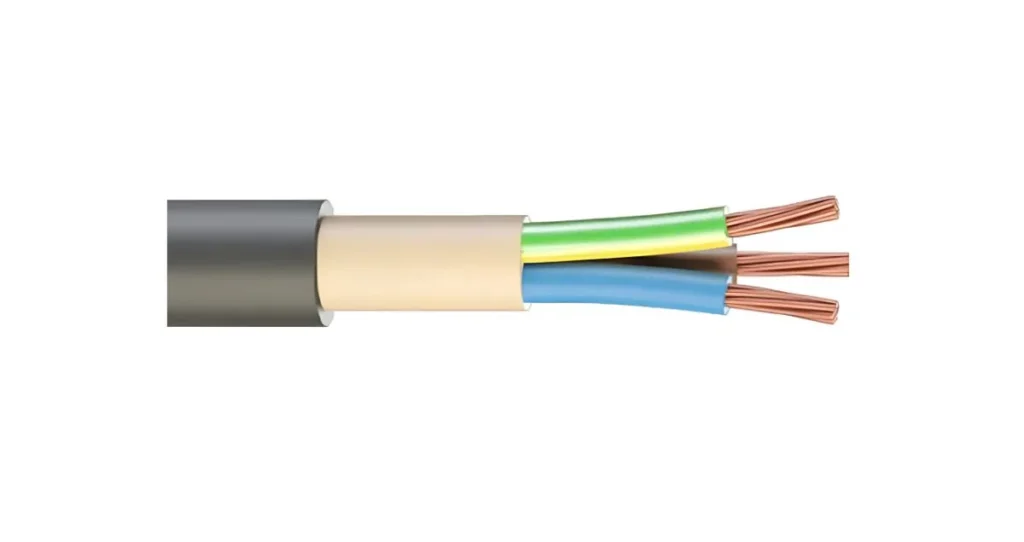
Guide to Hi-Tuff Cable for EV chargers: Electricians often need a cable that is tough, flexible, and reliable for outdoor work. Hi-Tuff (Doncaster TUFF SHEATH) provides a stranded, non-armoured solution for EV charging points, farm wiring, and external lighting. This guide explains when Hi-Tuff is best, how it compares to NYY-J, and when only SWA cables will meet BS 7671. It also introduces the EV-Ultra® Hi-Tuff with integrated Cat5e data cable, developed specifically for EV charge points, and highlights accessories such as EV cable clips for secure installs. [1][72]
Why Installers Choose Hi-Tuff
Hi-Tuff is widely used on-site because it combines rugged durability with ease of handling:
- Stranded copper conductors (Class 2): Always stranded, making it flexible and easier to terminate. [1]
- XLPE insulation (90 °C): Higher current-carrying capacity compared with standard PVC.
- Tough PVC sheath: Protects against abrasion and weather when surface run.
- Typical applications: Industrial wiring, distribution circuits, EV chargers, farm sheds, outdoor lighting, and temporary site power. [1]
In real-world installs, Hi-Tuff saves time and bends more easily than stiff solid-core alternatives.
EV Charging Installations
Hi-Tuff is a common choice for EV charger circuits when:
- The cable is clipped direct, in tray, or inside containment.
- Protection is provided by conduit or ducting.
- Flexibility at terminations is important.
For smart EV chargers that need data, the EV-Ultra® Hi-Tuff Cat5e cable is ideal. It combines 230 V stranded power conductors with a screened Cat5e FTP data cable inside one sheath, reducing install time and keeping the job neat. [72]
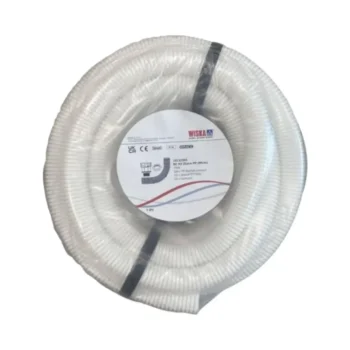
When routing EV charging cables neatly along walls, always use dedicated EV cable clips to keep runs secure, tidy, and compliant.
⚠️ For direct burial without ducts, Hi-Tuff must not be used. In this case, SWA (Steel Wire Armoured) cables are the BS 7671 compliant option.
Farm and Agricultural Wiring
Farm buildings demand robust but manageable cabling. Hi-Tuff is perfect for:
- Outbuildings and barns – surface clipped runs.
- Workshops and sheds – distribution feeds.
- Temporary power – where flexibility is essential.
For underground runs across farmyards, SWA cable is required for protection.
Outdoor Lighting Projects
Hi-Tuff is often used for external lighting because:
- It resists UV and weathering better than standard PVC flex.
- It is neat for surface runs and withstands knocks from tools or landscaping.
- Stranded conductors make it easier to terminate into lanterns or IP-rated fittings.
⚠️ Where cables must be buried directly into soil, always use SWA or duct Hi-Tuff for compliance. [1][5]

Hi-Tuff vs NYY-J Outdoors
- Hi-Tuff (TUFF SHEATH): Stranded conductors, XLPE insulation, flexible, rated 90 °C. [1]
- NYY-J: Commonly solid conductors (Class 1 RE) in small sizes, PVC insulated (70 °C), stiffer to work with but suitable for direct burial and in-concrete applications. [2][3][4]
The key takeaway: Hi-Tuff = stranded and flexible, NYY-J = often solid and stiff. That’s why Hi-Tuff is favoured for outdoor lighting and EV charger terminations.
FAQs – Guide to Hi-Tuff Cable for EV chargers
References
[1] Doncaster Cables TUFF SHEATH Datasheet (PDF)
[2] Eland Cables – NYY-J Datasheet
[3] Eland Cables – NYY-J & NYY-O Overview
[4] LAPP – NYY-J / NYY-O Range
[5] IET Wiring Regulations (BS 7671) Guidance
[72] Doncaster Cables EV-Ultra Cat5e Datasheet (PDF)



























Guide to Hi-Tuff Cable for EV Chargers