


What It Really Is – TUFF SHEATH, Not NYY-J
Guide to Hi-Tuff Cable: Electricians in the UK often use the phrase Hi-Tuff when talking about heavy-duty, non-armoured power cables. In reality, Hi-Tuff refers specifically to Doncaster Cables TUFF SHEATH — a stranded conductor cable with XLPE insulation and a tough PVC sheath. This guide explains what Hi-Tuff cable really is, how it differs from NYY-J, and when you should be using Steel Wire Armoured (SWA) Cables instead. [1]
Understanding Hi-Tuff Cable
Hi-Tuff cable is a tough-sheathed, non-armoured cable designed for fixed installations where durability is required but steel wire armouring is not.
Key construction features include:
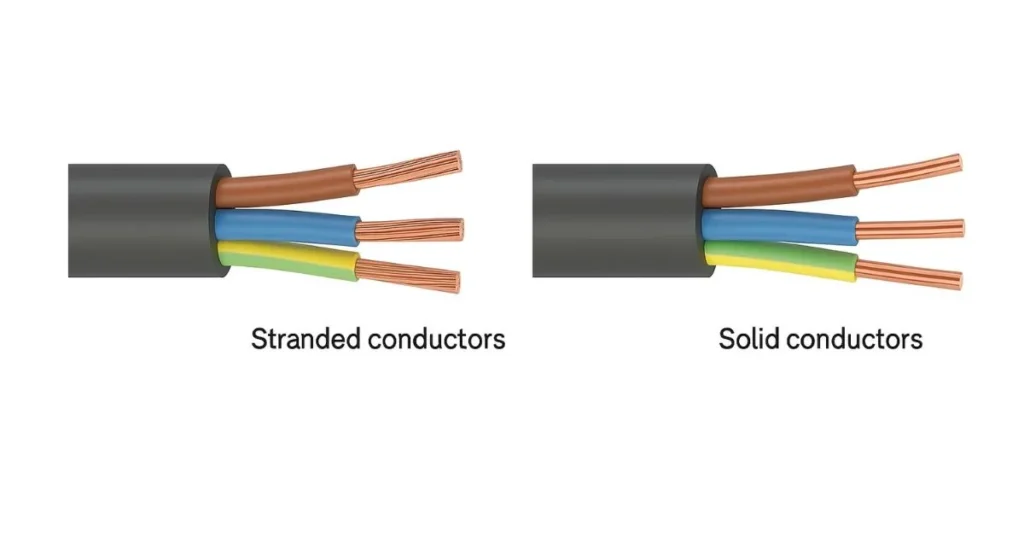
- Class 2 stranded copper conductors to BS EN 60228 (⚡ Hi-Tuff is always stranded — never solid).
- XLPE insulation providing higher current capacity and a 90 °C thermal rating.
- PVC bedding and tough PVC outer sheath for durability.
- Voltage rating: 600/1000 V.
- Operating temperature range: –15 °C to +90 °C.
- Minimum bend radius: 8× cable diameter. [1]
Hi-Tuff is popular in warehouses, factories, gantry wiring, farm buildings, and mains distribution thanks to its strength and flexibility.
Hi-Tuff Cable vs NYY-J – The Conductor Difference
The most common confusion in the trade comes down to conductors:
- Hi-Tuff (TUFF SHEATH): Always stranded (Class 2) for flexibility and easier handling. [1]
- NYY-J: Usually solid conductors (Class 1, RE) in smaller sizes, with stranded options only in larger cross-sections. [2][3][4]. Shop NYY-J Cable
This is the key distinction: Hi-Tuff is flexible stranded cable, while NYY-J is often stiff solid-core cable.
Hi-Tuff also benefits from XLPE insulation (90 °C), whereas NYY-J is PVC insulated (70 °C).
When to Use Hi-Tuff vs SWA
Hi-Tuff works well when you need a tough, non-armoured solution:
- Surface clipped runs
- On tray or ladder
- Embedded in concrete
- Industrial wiring in air
However, it should not be confused with SWA (Steel Wire Armoured) cable.
- Use Hi-Tuff: where mechanical damage is unlikely but durability is required.
- Use SWA: where BS 7671 requires armouring, or the environment poses impact/damage risk. [5]
Direct Burial & BS 7671 Compliance | Tuff Sheath
A crucial difference between cable families lies in burial rules:
- TUFF SHEATH (Hi-Tuff): May be buried only if mechanical protection (ducting or conduit) is provided. [1][5]
- NYY-J: Datasheets often state it is suitable for direct burial and concrete installs. However, BS 7671 still governs design and protection requirements. [2][3][4]
Even though Hi-Tuff insulation resists soil and chemicals, the Wiring Regulations require protective measures. For direct burial without ducts, SWA cables are the compliant choice.
Quick Spec Comparison – Hi-Tuff vs NYY-J
- Hi-Tuff (TUFF SHEATH):
- XLPE/PVC, 600/1000 V
- Always stranded conductors
- Temp range: –15 °C to +90 °C
- Bend radius: 8×Ø
- Burial only with duct/protection
- NYY-J:
- PVC/PVC, 0.6/1 kV
- Solid conductors in smaller sizes (stiffer)
- Stranded available in larger sizes
- Temp range: –15 °C to +70 °C
- Bend radius: 12×Ø
- Suitable for direct burial/in concrete (per datasheet)
FAQs – Guide to Hi-Tuff Cable
References
[1] Doncaster Cables TUFF SHEATH Datasheet (PDF)
[2] Eland Cables – NYY-J Datasheet
[3] Eland Cables – NYY-J & NYY-O Overview
[4] LAPP – NYY-J / NYY-O Range
[5] IET Wiring Regulations (BS 7671) Guidance





























Guide to Hi-Tuff Cable