

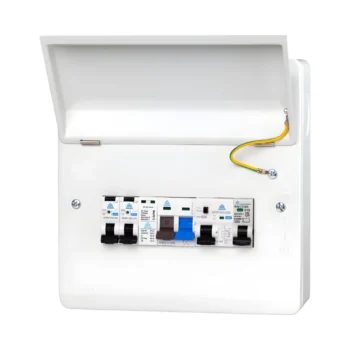
Whether you call it a consumer unit, fuse board, or fuse box, it’s often the smallest details—like proper cable gland selection—that define true quality and professionalism.
From securing twin & earth cables, to fitting meter tails, to terminating SWA cleanly, using the right cable glands not only ensures compliance with BS 7671, but also gives confidence that your work will pass the next EICR—even when it’s carried out by another spark.
Table of contents
What Are “Consumer Unit Glands”?
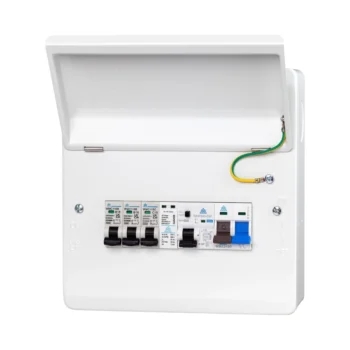
“Consumer unit glands” is a trade term used to describe the cable glands most commonly installed when wiring into:
- Metal or plastic consumer units
- What are still commonly referred to as fuse boards or fuse boxes – these are older or informal terms for consumer units, not separate products
These glands are used to secure:
- Twin & earth (T&E) fixed wiring
- Meter tails and earth conductors
- And in some cases, SWA cables or flexible round cables
In this post, we’ll focus mainly on T&E cable glands and meter tail entry glands, as these are by far the most common in domestic and small commercial installations. However, it’s worth noting that:
- If SWA cable is brought into the board (e.g. for submains or garage feeds), then a proper SWA gland (e.g. CW, BW, Storm, or WISKA Shield) can be used
- If round flexible cable is used (e.g. for boilers or EV chargers), a nylon compression gland is the most suitable option
These “consumer unit glands” are most often required when cables enter the enclosure from the top, bottom, or side—typically in surface entry installations where the cables are visible and exposed.
Rear Entry in Surface-Mounted Boards
By contrast, in the most common domestic setup, the consumer unit is surface-mounted, and the cables enter through rear knockouts, having been chased into the wall. This could be:
- Brick or block walls
- Plasterboard or stud walls
- Plywood or battened walls
In these cases, the cables are not exposed and cannot be pulled or disturbed like in surface-mounted scenarios. While glands are often not used for T&E entering through the rear, a grommet or bush must still be fitted around the metal edge of the knockout to prevent damage to the insulation—this is required for compliance with BS 7671.
However, SWA cables must always be terminated with a proper SWA cable gland, regardless of entry point. Even if the SWA enters through the rear of the unit, you must find a way to gland it correctly—whether that means using a recessed plate, modifying the rear entry area, or fitting the gland externally before feeding in.
Wherever rear entry isn’t used—or cable protection is needed at the entry point—consumer unit glands are essential for strain relief, sealing, and a clean, inspection-ready finish.
1. Membrane Glands – Neat Entry for Wall-Fed Flat and Round Cables
Membrane glands (membrane grommets) are a flexible and tidy solution for routing cables into a consumer unit, particularly when you need to accommodate:
- Multiple small round cables
- Flat cables (including twin & earth)
- Meter tails or earth conductors in multi-hole applications
These glands are made with a clip-in TPE membrane insert, allowing several cable types to pass through without drilling. They are available in both nylon and metal variants to suit a wide range of boards.
However, it’s important to note that membrane glands are not a direct replacement for standard T&E glands. They do not offer built-in strain relief and should only be used where:
- The cables are securely clipped before entry
- Additional strain protection is provided (e.g. trunking support, external fixings)
Specifications:
- Material: Polyethylene thermoplastic elastomer (TPE)
- Protection rating: IP66 (EN 60529)
- Temperature range: –40°C to +80°C
Best Practice: If the cable is subject to movement, pulling, or surface exposure, membrane glands must be paired with additional mechanical restraint to meet BS 7671 and EICR expectations.
They’re also a favourite when cables enter discreetly through the wall cavity. Many electricians achieve incredibly tidy installs by mounting membrane glands directly behind or beneath the DIN rail—so no entry points are visible from the front. The result? A super-clean consumer unit layout that looks sharp in person and even better on Instagram.
2. Glands for Twin & Earth (T&E) Cables
Recommended Glands:
- Flat-profile glands designed for twin & earth cable dimensions
- Typically made from nylon (PA6/PA66) or impact-resistant PVC
- Designed to provide both strain relief and mechanical protection when surface mounting cables into the top, side, or bottom of a consumer unit
These glands grip the flat profile of T&E cable securely, preventing slippage and movement while preserving the cable sheath and insulation. They are particularly important when cables are visible and exposed to disturbance.
BS 7671 Ref: Reg. 522.8.1 – Cable entry points must offer mechanical protection to prevent damage.
Twin & earth cables entering without strain relief or grommets are among the most frequently cited issues in unsatisfactory EICRs. A simple gland can prevent unnecessary faults and damage to the cable over time.
BS 7671 Ref: Reg. 522.8.1 – Cables must be protected from mechanical damage at points of entry.
Unsecured or chafing T&E is a common C3 or even C2 observation during EICRs—especially where bare steel knockouts are involved.
3. Glands for Meter Tails
Recommended Glands:
- Nylon meter tail glands with multi-hole rubber inserts
- Brass meter tail glands with identical sealing inserts – both versions are designed specifically for consumer units and offer the same high level of IP and flame resistance
Why It Matters:
- Maintains IP rating
- Prevents strain on main switch terminals
- Satisfies BS 7671 Reg. 134.1.1 – Safe construction, minimising danger
Loose meter tails are often flagged during EICRs as signs of poor workmanship.
Other Types of Cable Glands Used in Consumer Units
Glands for Flexible Cable Entry
Used for:
- Boilers or any adjacent equipment to consumer unit in a plant room
- EV charge points
- Adjacent intruder alarm etc
Recommended Glands:
- Nylon compression glands (typically M20/M25)
- Also available in metal versions (e.g. nickel-plated brass or stainless steel)
Materials:
- Polyamide (PA6 / PA66) for nylon versions — self-extinguishing and impact-resistant
- Brass or stainless steel for high-durability metal options
- Seals made from neoprene or thermoplastic elastomer (TPE) to maintain IP integrity
These glands are ideal for securing round flexible cables entering from the top, bottom, or sides of a consumer unit. When used correctly, they prevent moisture ingress, provide effective strain relief, and help maintain the enclosure’s IP rating.
BS 7671 Reg. 416.2.2 – Prevents access to live parts in normal operation.
Make sure the gland is appropriately sized for the cable diameter and tightened to compress the seal correctly—over-tightening can damage insulation, under-tightening may compromise IP rating.
SWA Glands into Consumer Units
If you’re bringing steel wire armoured cable into a consumer unit (e.g. for a garage feed or outbuilding submain):
Recommended Glands:
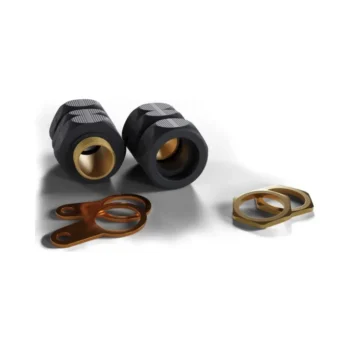
- BW / CW Glands (brass or stainless)
- IP68 Storm or WISKA Shield Glands
Always include:
- Banjo earth tag
- Earthing spring or ring lug
BS 7671 Regs:
- 543.7.1.201 – Earth continuity
- 522.8.5 – Mechanical protection at entry
A visually untidy or unearthed SWA gland is a dead giveaway in an EICR.
Why Eddy Currents Matter in Metal Boards
When meter tails or submains are routed through separate knockouts in steel consumer units, the alternating magnetic fields from live and neutral conductors can induce eddy currents in the metal enclosure. These circulating currents generate heat, even during normal operation. Over time, this can:
- Reduce the lifespan of the board
- Compromise fire integrity
- Lead to EICR failures, particularly when signs of heat damage are observed
This issue is especially relevant in high-load setups, such as EV charger installations, heat pump supplies, and multi-board commercial arrangements.
⚠ EICR Relevance
During an EICR, if the assessor finds signs of thermal stress or discolouration near separate cable entries, this may result in a C2 fault. Keeping tails grouped through a single gland not only avoids this but demonstrates adherence to safe, industry-recognised installation methods.
BS 7671 & Amendment 4 (Draft)
The proposed Amendment 4 to BS 7671 introduces some flexibility, but nothing has been finalised.
- Reg. 521.5.1 (current): Requires all conductors in a circuit to pass through the same opening in ferromagnetic enclosures
- Draft Amendment 4:
- Allows conductors up to 200A to pass through separate holes, but only if the installation has been temperature-rise tested and verified
- Above 200A, formal design calculations and safety verification will be mandatory
FAQs – Cable Glands for Consumer Units
Stay Connected with Electrical4Less
Looking for more practical installation advice and updates on the latest wiring regulations?
Follow us here:
- Facebook – Tips, Q&As, and trade insights
- Instagram – Real installs and product highlights
- YouTube – Product walkthroughs and short how-tos
Join thousands of UK electricians who choose Electrical4Less for fast delivery, solid stock, and the right advice.
Let me know if you’d like a full export with this clarification now merged in, or if you’d like additional tweaks to match internal page linking or SEO schema.
































Consumer Unit Glands – Precision That Speaks for Your Work